|
Size: 3444
Comment:
|
Size: 5875
Comment:
|
| Deletions are marked like this. | Additions are marked like this. |
| Line 1: | Line 1: |
| An annotation file contains labels of a surface, for example the sulci and gyri labels of a cortical surface. It is usally found in the subject_identifier/label/ folder. There is a separate annotation for left and right hemisphere, e.g. ?h.aparc.annot | (Note: There are a bunch of problems with this page. I've added some notes, but the result is not very satisfactory. -- GW) An annotation file contains labels of a surface, for example the sulci and gyri labels of a cortical surface. (... but only indirectly, as it actually records annotation values aka colors, NOT region labels. Labels can be derived from the colors given the ColorLut that's usually included. --GW) It is usally found in the subject_identifier/label/ folder. There is a separate annotation for left and right hemisphere, e.g. ?h.aparc.annot This page tells you how to display an annotation on tksurfer, read an annotation file into matlab or freesurfer. (Readers stumbling across this page might also like LabelsClutsAnnotationFiles --GW) |
| Line 4: | Line 10: |
| (... here "Overlay" just means "Show". In tksurfer, "overlay" is something else. --GW) |
|
| Line 10: | Line 18: |
| (4) Select and click ok. This will show the labels on the brain. | (4) Select and click ok. This will show the labels on the brain. (Not exactly. It shows annotation colors on the surface, and these often correspond to labels. --GW) |
| Line 12: | Line 20: |
| (5) To change view, click on pull-down menu: view->label style->outline. | (5) To change view, click on pull-down menu: view->label style->outline. |
| Line 28: | Line 36: |
| v = N x 1 vector, v(i) = i-1 (you can usually ignore v) | (1) v = N x 1 vector, v(i) = i-1 (you can usually ignore v) |
| Line 30: | Line 38: |
| L = N x 1 vector, L(i) = label of ith vertex of mesh | (2) L = N x 1 vector, L(i) = label of ith vertex of mesh |
| Line 32: | Line 40: |
| ct = colortable structure | (Not ''label'', but rather ''annotation value''. It looks to me like read_annotation reads in the array of ''annotation'' values, and does ''not'' translate those values to ''label numbers''. --GW) (3) ct = colortable structure |
| Line 35: | Line 45: |
| The colortable matches the label with the structure name. It also gives color to each structure type for visualization in tksurfer. In matlab, the colortable structure can be dissected as follows. | The colortable matches the label number (aka structure number -- GW) with the structure name. It also gives color to each label/structure for visualization in tksurfer. In matlab, the colortable structure can be dissected as follows. |
| Line 37: | Line 47: |
| ct.numEntries = # structures that are specified (scalar) | (1) ct.numEntries = # structures that are specified (scalar) |
| Line 39: | Line 49: |
| ct.orig_tab = location of riginal colortable (string). It's mainly for book-keeping | (2) ct.orig_tab = location (filepath -- GW) of original colortable (string). It's mainly for book-keeping |
| Line 41: | Line 51: |
| ct.struct_names = list of structure names (cell). The number of strings should be equal to the number of entries. For example, ct.struct_names{1} could be 'central sulcus' | (3) ct.struct_names = list of structure names (cell). The number of strings should be equal to the number of entries. For example, ct.struct_names{1} could be 'central sulcus' |
| Line 43: | Line 53: |
| ct.table = ct.numEntries x 5 matrix. Row i describes the color and label of the ith structure. ct.table(1,j) specifies the red color value of structure j (0 to 255). ct.table(2,j) specifies the green color value of structure j (0 to 255). ct.table(3, j) specifies the blue color value of structure j (0 to 255). ct.table(4,j) is all zeros. Finally ct.table(5,j) = ct.table(1,j) + ct.table(2,j)*2^8^ + ct.table(3,j)*2^16^ + 0*2^24^ = label given to structure j. | (4) ct.table = ct.numEntries x 5 matrix. Row i describes the color and label of the ith structure. ct.table(1,j) specifies the red color value of structure j (0 to 255). ct.table(2,j) specifies the green color value of structure j (0 to 255). ct.table(3, j) specifies the blue color value of structure j (0 to 255). ct.table(4,j) is all zeros (and is currently not used for anything). Finally ct.table(5,j) = ct.table(1,j) + ct.table(2,j)*2^8^ + ct.table(3,j)*2^16^ + 0*2^24^ = label given to structure j. |
| Line 46: | Line 56: |
| (The i's and j's here are confused -- GW). | |
| Line 50: | Line 61: |
| (2) use function: int MRISreadAnnotation(MRI_SURFACE *mris, char *sname). | (2) use function: int MRISreadAnnotation (MRI_SURFACE *mris, char *sname). |
| Line 58: | Line 69: |
| (6) The read annotation is stored in the field mris->vertices[vertex number].annotation (look at mrisurf.h for more details). | (6) (For each vertex...) The read annotation (value) is stored in the field mris->vertices[vertex number].annotation (look at mrisurf.h for more details). Note that mris->vertices[vertex number].annotation takes on values defined by the colortable. (Only sort of. First vtx->annotation gets the annotation value from the file, with no intervention of data from the colortable. It is indeed likely that annotation values may be found in the color part of the color table, but not necessarily so.--GW). |
| Line 60: | Line 71: |
| (7) If a colortable exists in the annotation file (which in general it should), then the colortable is stored in mris->ct | This is explained in the previous section on "What is a colortable". (7) If a colortable exists in the annotation file (which in general it should), then the colortable is stored in mris->ct. Note that the colortable in freesurfer is structured differently from that in matlab, but they basically contain the same information. See below: |
| Line 65: | Line 78: |
| mris->ct is the colortable struct that freesurfer uses. It's different from the matlab version of colortable. The structure can be found in colortab.h, but it can be summarized as follows: | mris->ct is the pointer to the colortable struct that freesurfer uses. It's different from the matlab version of colortable. The structure can be found in colortab.h, but it can be summarized as follows: |
| Line 67: | Line 80: |
| (1) mris->ct->nentries = # entries in colortable (i.e. the number of structures defined by colortable) (2) mris->ct->CTE[entry number] = pointer to a colortable entry (CTE). (3) mris->ct->CTE[n]->name = structure name of the nth structure in the colortable (4) mris->ct->CTE[n]->ri = red color [0-255] of the nth structure, [[BR]] mris->ct->CTE[n]->gi = green color [0-255] of the nth structure, [[BR]] mris->ct->CTE[n]->bi = blue color [0-255] of the nth structure, [[BR]] mris->ct->CTE[n]->ai = 0 (and this number is currently not used for anything). (5) mris->ct->CTE[n]->rf, mris->ct->CTE[n]->gf, mris->ct->CTE[n]->bf, mris->ct->CTE[n]->af are the corresponding values but from 0 to 1. = Document Author(s) = Not known |
(Note: There are a bunch of problems with this page. I've added some notes, but the result is not very satisfactory. -- GW)
An annotation file contains labels of a surface, for example the sulci and gyri labels of a cortical surface. (... but only indirectly, as it actually records annotation values aka colors, NOT region labels. Labels can be derived from the colors given the ColorLut that's usually included. --GW) It is usally found in the subject_identifier/label/ folder. There is a separate annotation for left and right hemisphere, e.g. ?h.aparc.annot
This page tells you how to display an annotation on tksurfer, read an annotation file into matlab or freesurfer.
(Readers stumbling across this page might also like LabelsClutsAnnotationFiles --GW)
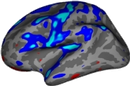
Overlay Annotation on Surface in Tksurfer
(... here "Overlay" just means "Show". In tksurfer, "overlay" is something else. --GW)
(1) Start tksurfer as usual: e.g. tksurfer subject lh inflated
(2) Click on pull down menu: File -> Select Label -> Import Annotation
(3) Browse and find the annotation file (they are usually found in the label folder)
(4) Select and click ok. This will show the labels on the brain. (Not exactly. It shows annotation colors on the surface, and these often correspond to labels. --GW)
(5) To change view, click on pull-down menu: view->label style->outline.
Faster way
(1) ctrl-right click on "Show Labels" Button
(2) Browse and find the annotation file (they are usually found in the label folder)
(3) Select and click ok. This will show the labels on the brain.
(4) To change view, click on "Draw Outlined Labels" button
Reading Into Matlab
[v, L, ct] = read_annotation(annotation_filename);
Suppose N is the number of vertices. Then,
(1) v = N x 1 vector, v(i) = i-1 (you can usually ignore v)
(2) L = N x 1 vector, L(i) = label of ith vertex of mesh
(Not label, but rather annotation value. It looks to me like read_annotation reads in the array of annotation values, and does not translate those values to label numbers. --GW)
(3) ct = colortable structure
What is a colortable (matlab version, see freesurfer version below)
The colortable matches the label number (aka structure number -- GW) with the structure name. It also gives color to each label/structure for visualization in tksurfer. In matlab, the colortable structure can be dissected as follows.
(1) ct.numEntries = # structures that are specified (scalar)
(2) ct.orig_tab = location (filepath -- GW) of original colortable (string). It's mainly for book-keeping
(3) ct.struct_names = list of structure names (cell). The number of strings should be equal to the number of entries. For example, ct.struct_names{1} could be 'central sulcus'
(4) ct.table = ct.numEntries x 5 matrix. Row i describes the color and label of the ith structure. ct.table(1,j) specifies the red color value of structure j (0 to 255). ct.table(2,j) specifies the green color value of structure j (0 to 255). ct.table(3, j) specifies the blue color value of structure j (0 to 255). ct.table(4,j) is all zeros (and is currently not used for anything). Finally ct.table(5,j) = ct.table(1,j) + ct.table(2,j)*28 + ct.table(3,j)*216 + 0*224 = label given to structure j.
Therefore if vertex i is labeled structure j. Then L(i) = ct.table(5, j). (The i's and j's here are confused -- GW).
Reading Annotation Files into Freesurfer
(1) #include "mrisurf.h"
(2) use function: int MRISreadAnnotation (MRI_SURFACE *mris, char *sname).
(3) Returns NO_ERROR if successful.
(4) *mris is the freesurfer surface structure
(5) sname is the filename of the annotation file. sname can be the full path or just the filename. If it's not a full path, then function will use the directory where the surface mris was read from.
(6) (For each vertex...) The read annotation (value) is stored in the field mris->vertices[vertex number].annotation (look at mrisurf.h for more details). Note that mris->vertices[vertex number].annotation takes on values defined by the colortable. (Only sort of. First vtx->annotation gets the annotation value from the file, with no intervention of data from the colortable. It is indeed likely that annotation values may be found in the color part of the color table, but not necessarily so.--GW).
This is explained in the previous section on "What is a colortable".
(7) If a colortable exists in the annotation file (which in general it should), then the colortable is stored in mris->ct. Note that the colortable in freesurfer is structured differently from that in matlab, but they basically contain the same information. See below:
Colortable (Freesurfer version)
The colortable matches the label with the structure name. It also gives color to each structure type for visualization in tksurfer.
mris->ct is the pointer to the colortable struct that freesurfer uses. It's different from the matlab version of colortable. The structure can be found in colortab.h, but it can be summarized as follows:
(1) mris->ct->nentries = # entries in colortable (i.e. the number of structures defined by colortable)
(2) mris->ct->CTE[entry number] = pointer to a colortable entry (CTE).
(3) mris->ct->CTE[n]->name = structure name of the nth structure in the colortable
(4) mris->ct->CTE[n]->ri = red color [0-255] of the nth structure, BR mris->ct->CTE[n]->gi = green color [0-255] of the nth structure, BR mris->ct->CTE[n]->bi = blue color [0-255] of the nth structure, BR mris->ct->CTE[n]->ai = 0 (and this number is currently not used for anything).
(5) mris->ct->CTE[n]->rf, mris->ct->CTE[n]->gf, mris->ct->CTE[n]->bf, mris->ct->CTE[n]->af are the corresponding values but from 0 to 1.
Document Author(s)
Not known