|
Size: 43
Comment:
|
Size: 3562
Comment:
|
| Deletions are marked like this. | Additions are marked like this. |
| Line 1: | Line 1: |
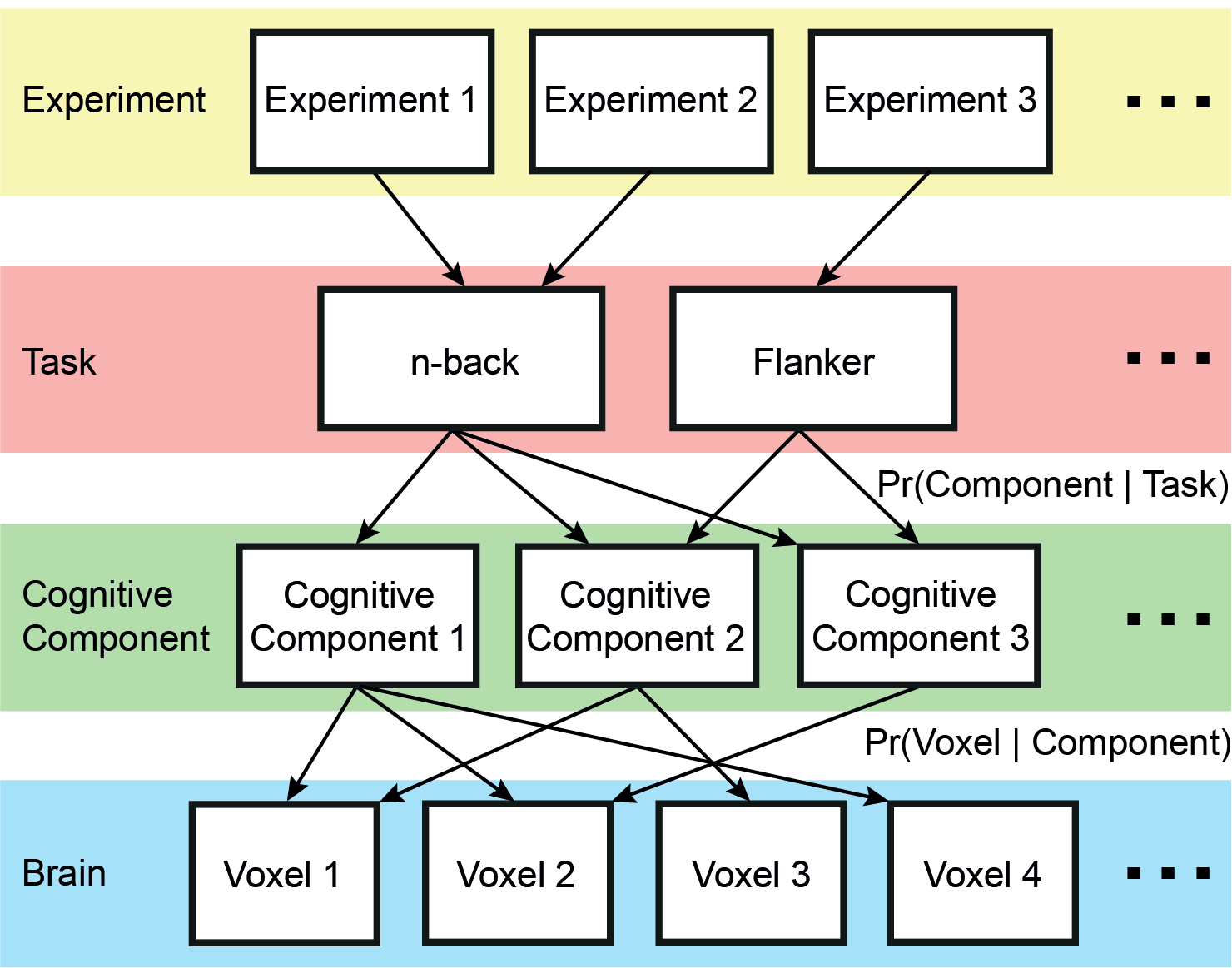
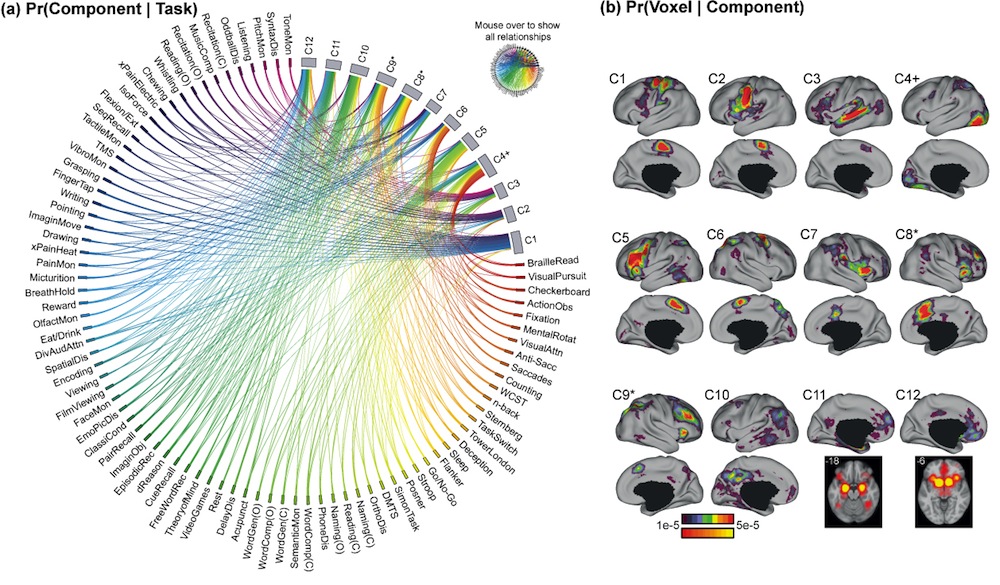
| Describe BrainmapComponents_Yeo2014 here. | [[FreeSurferWiki|top]] = Specialization and Flexibility in Human Association Cortex = ||We applied a hierarchical Bayesian model (figure on right) on 10,449 Brainmap experiments across 83 behavioral tasks. By formalizing the notion that performing a task engages multiple cognitive components, each supported by overlapping brain regions, we identified cognitive components that are shared across tasks. The estimated components enabled the derivation of quantitative maps of functional specialization, revealing complex zones of frontal and parietal regions ranging from being highly specialized to highly flexible. An independent resting-state fMRI dataset (N=1000) was used to explore the network organization of the specialized and flexible regions. Cortical regions specialized for the same components were strongly coupled, suggesting that components function as partially isolated networks. Functionally flexible regions participate in multiple components to different degrees. This heterogeneous selectivity was strongly predicted by the connectivity between functionally flexible and specialized regions. Functionally flexible regions might support the core of the brain’s information processing capacity, binding or integrating the processing power of segregated, specialized brain networks. The estimated components in FreeSurfer fsaverage space and MNI152 space, as well as specificity and flexibility estimates are available for download. || {{attachment:BrainmapCognitiveOntology_Yeo2014_model.png|Hierarchical Bayesian Model| width=400 height=233}}|| == References == [[ |Yeo BTT, Krienen FM, Eickhoff SB, Yaakub SN, Fox PT, Buckner RL, Asplund CL, Chee MWL. Functional Specialization and Flexibility in Human Association Cortex. Submitted.]] == 12-Component Cognitive Ontology == {{attachment:BrainmapCognitiveOntology_Yeo2014_12ComponentOverview.jpg|12-Component Estimate| width=800 height=600}} == Downloads == [[http://www.ece.nus.edu.sg/stfpage/ybtt/papers/2014Brainmap/Interactive/index.html|Interactive version of 12-component Ontology]] We found the interactive version of the above figure extremely useful. [[ftp://surfer.nmr.mgh.harvard.edu/pub/data/Yeo_JNeurophysiol11_FreeSurfer.zip|Resting State Cortical Parcellation in fsaverage, fsaverage6 and fsaverage5 Space]]. These subjects are also currently in the developmental version of FreeSurfer which can be accessed from the Martinos center network (/autofs/cluster/freesurfer/centos4.0_x86_64/dev/subjects/). These subjects will be officially included in some future FreeSurfer release. Note however, the zip file linked here corresponds exactly to that from the reference, while functional parcellations in the developmental and official release versions of FreeSurfer are subjected to modifications/improvements. ==== Example Usage ==== See README in unzipped folder == Other downloads == [[http://sumsdb.wustl.edu:8081/sums/directory.do?id=8286317|Cerebral Surface Parcellations in Caret Space]] [[http://www.youtube.com/user/YeoKrienen|Movies of Cortical Seed-based Functional Connectivity]] [[http://surfer.nmr.mgh.harvard.edu/fswiki/CerebellumParcellation_Buckner2011|Cerebellar Parcellation in MNI Space]] [[http://www.youtube.com/BucknerKrienen|Movies of Cerebellar Seed-based Functional Connectivity]] [[http://surfer.nmr.mgh.harvard.edu/fswiki/StriatumParcellation_Choi2012| Striatum Parcellation in MNI Space]] [[http://people.csail.mit.edu/danial/Site/Code.html| Code for the von Mises-Fisher Mixture Model Clustering]] |
Specialization and Flexibility in Human Association Cortex
We applied a hierarchical Bayesian model (figure on right) on 10,449 Brainmap experiments across 83 behavioral tasks. By formalizing the notion that performing a task engages multiple cognitive components, each supported by overlapping brain regions, we identified cognitive components that are shared across tasks. The estimated components enabled the derivation of quantitative maps of functional specialization, revealing complex zones of frontal and parietal regions ranging from being highly specialized to highly flexible. An independent resting-state fMRI dataset (N=1000) was used to explore the network organization of the specialized and flexible regions. Cortical regions specialized for the same components were strongly coupled, suggesting that components function as partially isolated networks. Functionally flexible regions participate in multiple components to different degrees. This heterogeneous selectivity was strongly predicted by the connectivity between functionally flexible and specialized regions. Functionally flexible regions might support the core of the brain’s information processing capacity, binding or integrating the processing power of segregated, specialized brain networks. The estimated components in FreeSurfer fsaverage space and MNI152 space, as well as specificity and flexibility estimates are available for download. |
|
References
12-Component Cognitive Ontology
Downloads
Interactive version of 12-component Ontology We found the interactive version of the above figure extremely useful.
Resting State Cortical Parcellation in fsaverage, fsaverage6 and fsaverage5 Space. These subjects are also currently in the developmental version of FreeSurfer which can be accessed from the Martinos center network (/autofs/cluster/freesurfer/centos4.0_x86_64/dev/subjects/). These subjects will be officially included in some future FreeSurfer release. Note however, the zip file linked here corresponds exactly to that from the reference, while functional parcellations in the developmental and official release versions of FreeSurfer are subjected to modifications/improvements.
Example Usage
See README in unzipped folder
Other downloads
Cerebral Surface Parcellations in Caret Space
Movies of Cortical Seed-based Functional Connectivity
Cerebellar Parcellation in MNI Space
Movies of Cerebellar Seed-based Functional Connectivity