|
Size: 1216
Comment:
|
Size: 1387
Comment:
|
| Deletions are marked like this. | Additions are marked like this. |
| Line 1: | Line 1: |
| Correction for Multiple Comparisons/Cluster Analysis (Volume) | == Correction for Multiple Comparisons / Cluster Analysis == |
| Line 3: | Line 3: |
| With so many voxels in fMRI maps, it is very likely that many voxels will appear to be active purely by random chance (ie, a false positive). The is known as the "Problem of Multiple Comparisons". One way around this is to do a cluster analysis in which active voxels are eliminated unless they appear in a cluster, the idea being that false positives will not appear next to each other. | === Volume === |
| Line 5: | Line 5: |
| This program (mri_volcluster) will find clusters in a volume. A cluster is a set of contiguous voxels which meet a threshold criteria. The set may also have to reach a certain minimum number of voxels to be considered a cluster. The results can be saved in four ways: (1) a text summary file, (2) a new volume which is same as the input volume but with all the voxels that do not belong to a cluster set to zero, (3) a volume with each voxel's value equal to the cluster number in the summary file to which the voxel belongs, and (4) one cluster can be saved as a label file. The search space within the volume can be restricted to be within a mask. Two voxels are considered contiguous if they share a common row, column, or slice (except for --allowdiag). | With so many voxels in fMRI maps, it is very likely that many voxels will appear to be active purely by random chance (ie, a false positive). This is known as the "Problem of Multiple Comparisons". One way around this is to do a cluster analysis in which active voxels are eliminated unless they appear in a cluster, the idea being that false positives will not appear next to each other. The command mri_volcluster identifies clusters of activations that meet specified criteria. It then creates images, summary files and even numbered labels for the output clusters. The search space within the volume can be restricted to be within a mask. Two voxels are considered contiguous if they share a common row, column, or slice (except for --allowdiag). Relevant literature: [[http://www.ncbi.nlm.nih.gov/pubmed/17011792|Smoothing and cluster thresholding for cortical surface-based group analysis of fMRI data. Hagler DJ Jr, Saygin AP, Sereno MI. NeuroImage (2006)]]. === Surface === The same idea applies to data on a surface (vertices). The command mri_surfcluster identifies clusters of vertices that meet specified criteria. Relevant literature: Hayasaka and Nichols (2003) ([[ftp://surfer.nmr.mgh.harvard.edu/transfer/outgoing/flat/greve/hayasaka.2003.ni.1014.clustersize.pdf|pdf]]) |
Correction for Multiple Comparisons / Cluster Analysis
Volume
With so many voxels in fMRI maps, it is very likely that many voxels will appear to be active purely by random chance (ie, a false positive). This is known as the "Problem of Multiple Comparisons". One way around this is to do a cluster analysis in which active voxels are eliminated unless they appear in a cluster, the idea being that false positives will not appear next to each other.
The command mri_volcluster identifies clusters of activations that meet specified criteria. It then creates images, summary files and even numbered labels for the output clusters. The search space within the volume can be restricted to be within a mask. Two voxels are considered contiguous if they share a common row, column, or slice (except for --allowdiag).
Relevant literature: Smoothing and cluster thresholding for cortical surface-based group analysis of fMRI data. Hagler DJ Jr, Saygin AP, Sereno MI. NeuroImage (2006).
Surface
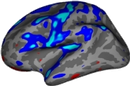
The same idea applies to data on a surface (vertices). The command mri_surfcluster identifies clusters of vertices that meet specified criteria.
Relevant literature: Hayasaka and Nichols (2003) (pdf)