|
Size: 2029
Comment:
|
Size: 22340
Comment:
|
| Deletions are marked like this. | Additions are marked like this. |
| Line 1: | Line 1: |
| == FreeSurfer Tutorial and Workshop == [[http://hima/cgi-bin/register.cgi|Registration is now OPEN for the upcoming course!]] Registration Deadline is January 2, 2009 === Courses === January 20 & 21, 2009 149 Thirteenth Street, Charlestown, MA === Description === The !FreeSurfer Development Team is hosting a two-day course for beginner and experienced users of !FreeSurfer. Day 1 will be an introduction to !FreeSurfer (or a refresher for those more experienced). Day 2 will cover everything you need to know for analyzing your data. Topics are listed below. Registration Deadline is January 2, 2009. There are only 24 available spots for this course. Laptops will be provided which will have !FreeSurfer already installed. You may bring your own laptop and/or your own data, however it is advised you install !FreeSurfer on it and test it ahead of time. There will be time at the end of Day 1 to learn how to install !FreeSurfer but please keep in mind that there might not be enough time to resolve any specific technical issues that may arise. === Schedule === Day 1: Introduction to FreeSurfer * Unix Tutorial (optional) * Introduction to FreeSurfer * FreeSurfer Applications * Reliability/Validation of FreeSurfer * Analyzing the Individual Subject * Interaction with Individual Subject Data * Group Analysis/GLM * QDEC * Multiple Comparisons * Group Analysis Interactive Tutorial * FreeSurfer Installation on Personal Laptops (optional) * Start Processing Your Own Data (optional) Day 2: Advanced FreeSurfer: Working with Various Data Types * Registration for Multi-Modal Integration * Working with fMRI and Diffusion Data * Working with Different Format Types * Segmentation/ROI Analysis * Working with FreeSurfer Stats * Surface-Based Multi-Modal Analysis * Bug Reporting * Question and Answer Session * Future Directions of FreeSurfer * Combined Volume and Surface Registration * Tractography of Underlying Anatomy (TRACULA) |
#acl LcnGroup:read,write,delete,revert All:read ##<<TableOfContents>> = Upcoming FreeSurfer Workshops = == Next Boston course? == The next Boston course will be held October 27th through 29th, 2014. '''Registration will open at 3:30 on 9/25/14!''' ##REGISTRATION IS NOW OPEN! Note: fMRI analysis is '''not''' taught during the Fall course. ##[[https://surfer.nmr.mgh.harvard.edu/cgi-bin/fsurfer/register.6069.cgi|Click here to register!]] <<BR>> The payment deadline is '''October 6, 2014''' for all payment forms except for institutional check. The payment deadline for those sending an institutional check is October 20, 2014. ##The next course at the Martinos Center will be held on May 5th, 6th, & 7th, 2014. <<BR>> The course will be held at the [[http://maps.google.com/maps?q="114%20Sixteenth%20Street,%20Charlestown,%20MA%2002129"|Martinos Center for Biomedical Imaging in Boston]] (114 Sixteenth Street, Charlestown, MA 02129). ##'''Registration is not yet open.''' <<BR>>To be notified of when it will open & to receive other course-related emails, sign up ##for the [[http://surfer.nmr.mgh.harvard.edu/cgi-bin/fsurfer/interest.cgi|course mailing list]]. The typical schedule for the Fall (Diffusion) course can be found [[http://surfer.nmr.mgh.harvard.edu/fswiki/FsTutorial/Oct2014CourseSchedule|here]].<<BR>> The typical schedule for the Spring (fMRI) course can be found [[http://surfer.nmr.mgh.harvard.edu/fswiki/FsTutorial/May2014CourseSchedule|here]]. == Next International course? == === Sao Paulo Course === We are currently planning a course in Sao Paulo, Brazil for Spring 2015. Details will be available soon. == General Information == Details about the Boston Course can be found [[http://surfer.nmr.mgh.harvard.edu/fswiki/CourseDescription#BostonCourseDetails|below]]. Information about international courses can be found on their respective websites. If you have a specific question about the !FreeSurfer courses that was not answered by our [[http://surfer.nmr.mgh.harvard.edu/fswiki/CourseDescription#FAQ|FAQ]] or would like to host a course in your area, you can email Allison Stevens (astevens at nmr dot mgh dot harvard dot edu) who organizes the courses. ---- == Course Mailing List == '''SUBSCRIBE''':<<BR>> If you are interested in being notified about future course offerings, sign up for our mailing list ([[http://surfer.nmr.mgh.harvard.edu/cgi-bin/fsurfer/interest.cgi|here]]). <<BR>> '''UNSUBSCRIBE''':<<BR>> To unsubscribe from the course mailing list please click [[https://surfer.nmr.mgh.harvard.edu/cgi-bin/fsurfer/unsubscribe.cgi|here]]. -------- == Boston Course Details == '''Click on any of the topics below for more information: <<BR>> [[http://surfer.nmr.mgh.harvard.edu/fswiki/CourseDescription#Overview|Overview]] <<BR>> [[http://surfer.nmr.mgh.harvard.edu/fswiki/CourseDescription#Payment|Payment]] <<BR>> [[http://surfer.nmr.mgh.harvard.edu/fswiki/CourseDescription#FAQ|FAQ]] <<BR>> [[http://surfer.nmr.mgh.harvard.edu/fswiki/CourseDescription#CourseTopics|Topics Covered During the Course]] <<BR>> [[http://surfer.nmr.mgh.harvard.edu/fswiki/CourseDescription#LecturersandStaff|Lecturers and Staff]] <<BR>> [[http://surfer.nmr.mgh.harvard.edu/fswiki/CourseDescription#Accommodations|Accommodations]] <<BR>> [[http://surfer.nmr.mgh.harvard.edu/fswiki/CourseDescription#Directions|Directions]] <<BR>> [[http://surfer.nmr.mgh.harvard.edu/fswiki/CourseDescription#Parking|Parking]] <<BR>> [[http://surfer.nmr.mgh.harvard.edu/fswiki/CourseDescription#Map|Map of the Course Location]]''' ==== Overview ==== The !FreeSurfer Development Team hosts a '''three-day''' course for beginner and experienced users of !FreeSurfer. '''Day 1''' caters to beginners and will cover: . An introduction to !FreeSurfer <<BR>> Surface-based analysis<<BR>> Troubleshooting <<BR>> '''Day 2''' will cover: . ROI analysis <<BR>> Multi-modal integration <<BR>> Group analysis <<BR>> '''Day 3''' will cover: . Longitudinal analysis<<BR>> Functional analysis (during the Spring course) <<BR>> Diffusion processing (during the Fall course) The three days will run roughly from '''9am-5:30pm'''. Laptops are provided with !FreeSurfer and the tutorial data already installed. Attendees will work in pairs (sharing a laptop). '''The most recent Boston course schedule can be found [[http://surfer.nmr.mgh.harvard.edu/fswiki/FsTutorial|here]].''' Please check back for updates. Additional topics and more detail on each topic is provided below. ==== Payment ==== ===== Cost ===== The fee for the course is $680. A reduced rate of $480 is available to graduate students. ''MDs, !PhDs, and post-docs do not qualify for the graduate student rate!'' ===== Guidelines ===== ##Payment is due immediately upon registration. <<BR>> The Payment deadline is '''October 6, 2014''' for all payment forms except for institutional check. The payment deadline for those sending an institutional check is October 20, 2014.<<BR>><<BR>> Payment and all questions about payment should sent to Stacey Ladieu (sladieu at martinos dot org).<<BR>> ##Check and cash are the only forms of accepted payment. <<BR>> ##'''Credit cards are not accepted'''. ===== Checks ===== '''Make checks payable to''': Massachusetts General Hospital Mail checks to this address:<<BR>> Stacey Ladieu<<BR>> Athinoula A. Martinos Center for Biomedical Imaging<<BR>> 149 Thirteenth Street - Room 2301<<BR>> Charlestown, MA 02129<<BR>> Please be sure the '''name of the person taking the course''' is listed on the check. ===== Cash ===== There are two options for paying by cash: 1. Make an appointment with Allison Stevens (astevens at martinos dot org) to deliver cash in person 1. Contact Stacey (sladieu at martinos dot org) to send cash via Western Union or Moneygram. The transfer must be made out to Stacey Ladieu. ===== Deadlines ===== If payment has not been received by the payment deadline ''or'' in the case of an institutional check, your institution has not contacted Stacey Ladieu (sladieu at martinos dot org) with details of their payment arrangement by that date, your spot will be opened to the waiting list. There is no need to contact us to check whether your payment has gone through - your spot is safe unless ''we'' contact you. Course fees are refundable up to the payment deadline. A $200 fee will be deducted, should you request a refund up to 2 weeks prior to the program. After that, the tuition can be applied to a future program or you can send someone in your place. In the case there are less than 10 registrants for the course, the course will be cancelled and the registration fee will be refunded to the registrant. ==== FAQ ==== 1. '''How many individuals are accepted into the Boston course?''' * 50 people 1. '''Do postdocs qualify for the student rate?''' * No, sorry. 1. '''Is there a discount for MGH or Martinos Center employees?''' * Sorry, no. 1. '''I cannot pay by check or credit card. Do I have any other options?''' * If you are local, you may bring a cash payment to Allison Stevens (astevens at nmr dot mgh dot harvard dot edu) before the deadline. If you are not local, you can pay via Western Union and Moneygram if it is addressed to Stacey Ladieu. Please contact Stacey (sladieu at nmr dot mgh dot harvard dot edu) first for details. 1. '''Payment is required with registration but my institution will take several weeks to cut a check. Does this mean I cannot attend?''' * You may still attend the course. Have the person at your institution that is responsible for arranging your payment contact Stacey Ladieu (sladieu at nmr dot mgh dot harvard dot edu) to verify that a request for payment has been submitted and is being processed. 1. '''The course is full. Can you register me for the next one?''' * You can sign up for our course mailing list and you will be notified when registration for the next course opens (that list is [[http://surfer.nmr.mgh.harvard.edu/cgi-bin/fsurfer/interest.cgi|here]]). You can also register for the currently full course to be put on the waiting list for it. This does not however automatically get you a spot in the next course. 1. '''Can I get a receipt for the course?''' * Sure! Paper receipts will be available on the first day of the course. If you need a receipt or invoice before then to get a check issued or reimbursed, please use the confirmation email you received when you registered for the course. 1. '''How do I know if my payment went through?''' * If it hasn't we will contact you. 1. '''Do I get any credits for taking this course?''' * Nope, but we will give you a certificate to prove you took it. 1. '''Do you serve any food at the course?''' * There will be a continental breakfast each morning & coffee and some snacks supplied in the afternoon. There is also a cafeteria nearby where the course is held and two cafes 2-3 blocks from the building. 1. '''I have some data I would like to get your opinion on. Can I show it to you?''' * Sure! But please know that if you show us during a tutorial, questions from students about that tutorial will have to take priority over personal data questions. If you email Allison prior to the course, she can try to arrange some help. 1. '''I need some help installing !FreeSurfer on my laptop - I can't seem to get it to work. Can you help with that?''' * Sure! Please see the response to the question above. 1. '''Can I bring my own laptop to work on instead of sharing with someone else? ''' * If any issues arise during the tutorial sessions which are unique to your laptop, we will not be able to troubleshoot those issues for you (it takes staff away from answering general tutorial questions). We strongly discourage using your own laptop instead of the ones we provide. If you insist on working on your laptop, please thoroughly test your installation ahead of time - guidelines for this can be found on the TestingFreeSurfer wiki. It might also be a good idea to try to run all the commands in the tutorials ([[https://surfer.nmr.mgh.harvard.edu/fswiki/FsTutorial|here]]). 1. '''How far is the airport from the course location? ''' * About 20 minutes by taxi and 1 hour by public transportation (there are several transfers). The taxi will cost $20-$25. Public transportation will cost under $3. 1. '''Would it work if I scheduled a flight for the evening of the last day of the class?''' * Certainly. You can bring your luggage to the room where the course is held and leave straight from there. Traffic can be bad after 3pm, so you may need 45 minutes to an hour to get to the airport. To attend all the talks on the last day, your flight will need to be 8pm or later. ## 1. '''I can only pay for the course with credit card so that I can be reimbursed later. Is this okay?''' ## * Sorry, we have not found a way to be able to accept credit cards. Payment must be by check or cash. ==== Course Topics ==== Below is the list of topics. The course format is composed of lectures followed by hands-on tutorials so that you can gain experience interacting with data processed by !FreeSurfer. A basic understanding of Unix is necessary to run and work with !FreeSurfer. ===== Day 1: Introduction / Single Subject / Troubleshooting ===== * '''Unix Tutorial (optional)''' * This unix tutorial is very basic. '''Scripting will not be covered.''' This tutorial will cover how to to navigate (cd) through directories, how to copy files, how to make directories, how to use emacs, and how to set variables. For those who are not familiar with UNIX, this tutorial is meant to get you comfortable enough to at least get through the !FreeSurfer tutorials that are part of the course. If you have never used UNIX before, this session is highly recommended. * '''Introduction to !FreeSurfer Jargon (optional)''' * Intended for those new to imaging software. Explains basic vocabulary such as voxel, surface, vertex, volume, segmentation, parcellation, registration, and recon. * '''Introduction to !FreeSurfer''' * Overview of !FreeSurfer's abilities. * '''Analyzing the Individual Subject in !FreeSurfer''' * Description of each step of the !FreeSurfer processing stream. * '''Interaction with Individual Subject Data - Tutorial''' * Using !FreeSurfer's visualization tools to look at !FreeSurfer output. * '''A Non-physicist's Intro to MR (optional)''' * A short introduction to the basic processes underlying MR imaging, with an emphasis on intuitive explanations for non-physicist MR users. * '''Failure Modes and Troubleshooting with !FreeSurfer - Talk and Tutorial''' * Discussion of the possible errors one may find in their !FreeSurfer output and how to fix them. * '''Quality Checking a Recon ''' * Live demo of how to scroll through !FreeSurfer output and look for errors. ## * '''!FreeSurfer Installation on Personal Laptops (optional)''' ## * Help with the installation of !FreeSurfer on your personal laptop. Downloading the software ahead of time is recommended. ## * '''Start Processing Your Own Data (optional)''' ## * Guidance on how to run a recon on your own subject data. Please come with !FreeSurfer installed on your laptop and with data you would like to process. ## * !FreeSurfer Applications ## * Examples of studies done using !FreeSurfer ===== Day 2: ROIs / Multimodal / Group Analysis ===== * '''Surface-based Smoothing/Surface-based Registration''' * Volume vs. Surface-based analysis * '''Region of Interest (ROI) Analysis - Talk and Tutorial ''' * A description of the !FreeSurfer atlases used in subcortical segmentation and cortical parcellation as well as the measures !FreeSurfer provides. Information on creating and analyzing ROIs (volume vs. intensity studies). * '''Group Analysis/GLM/Multiple Comparisons (mri_glmfit)- Talk and Tutorial''' * Covers the basics of group analysis in the context of imaging data. * '''QDEC (group analysis software) - Talk and Tutorial''' * Introduction to a user-friendly tool for conducting group analyses. * '''Multi-Modal Integration - Talk and Tutorial''' * Introduction on how !FreeSurfer output can be used with other modalities (i.e. fMRI data, diffusion data) ===== Day 3: fMRI or Diffusion / Longitudinal / Q&A ===== * '''Basics of fMRI Analysis''' (only in the Spring) * Covers the basics of functional MRI data analysis, spanning preprocessing to single-subject and group-level analyses. Topics include motion correction, B0 distortion correction, spatial normalization, spatial smoothing, hemodynamic modeling, GLM analysis, contrasts and hypothesis testing, and Random-, Fixed-, and Mixed-Effects group analyses. * '''FSFAST''' (only in the Spring) * Preprocessing of fMRI (motion correction, slice-timing correction, smoothing, registration to the anatomical, sampling to the common group space in the surface and volume), setting up and running block and event-related analysis, adding nuisance variables to the analysis, performing the individual fMRI time series fMRI analysis, performing group fMRI analysis in the volume and on the surface. * '''Diffusion Data Processing and TRACULA talks and tutorial''' (only in the Fall) * How to process diffusion MRI data to extract basic diffusion measures and to reconstruct white-matter pathways using !FreeSurfer's ''new'' tractography tool. * '''Motion-compensated neuroanatomical imaging (optional)''' * While real-time fMRI motion correction has been available with some MRI scanners for years (e.g. Siemens' PACE), effective real-time motion correction in neuroanatomical imaging is just now becoming available. This talk focuses on the motion-correction system we have developed for the Siemens platform, but also discusses the current developments on the GE platform. * '''MRI Acquisition Methods for Morphometry (optional)''' * A description of how using different scan protocols can affect data quality and !FreeSurfer reconstruction. * '''Registration Methods (optional)''' * Overview of different registration methods discussed so far (flirt, robust_register, bbregister) and introduction of a new registration tool, CVS (combined volume and surface registration). * '''Longitudinal Analysis in !FreeSurfer''' * How to process longitudinal data with !FreeSurfer and what's going on behind the scenes. * '''Future Directions of !FreeSurfer''' * Inferring architectonic boundaries from in-vivo MRI - Bruce Fischl * Techniques for inferring the location of architectonic features in the brain in vivo * '''Question and Answer Session''' * Open forum to resolve any unanswered questions ## * Accuracy, Reliability, and Validation of Data using !FreeSurfer ==== Lecturers and Staff ==== * Bruce Fischl * Doug Greve * Andre van der Kouwe * Martin Reuter * David Salat * Nick Schmansky * Allison Stevens * Dylan Tisdall * Anastasia Yendiki * Lilla Zollei * Jonathan Polimeni * Zeke Kaufman * Caroline Magnain * Ender Konukoglu * Dorit Kliemann * Allison Moreau * Ani Varjabedian * Lee Tirrell ==== Accommodations ==== For discounted hotel options, please see [[https://www.nmr.mgh.harvard.edu/training/accommodations|this website]]. To get to Downtown Boston from Charlestown you can take the shuttle (it runs every 15 minutes during the day on weekends), [[http://mbta.com/schedules_and_maps/boats/lines/default.asp?route=F4|the water shuttle]], or [[http://mbta.com/schedules_and_maps/bus/routes/?route=93|the #93 bus]]. Shuttle bus stops are marked on the Map at the end of this page. ==== Directions ==== The !FreeSurfer Course is being held at the Martinos Center for Biomedical Imaging in Boston. Here is a [[http://maps.google.com/maps?q="114%20Sixteenth%20Street,%20Charlestown,%20MA%2002129"|map]]: . Building 114, Conference Room D1<<BR>> 114 Sixteenth Street<<BR>> Charlestown Navy Yard (CNY)<<BR>> Charlestown, MA 02129-2020 When you enter Building 114, take the door on your left. Follow the signs or let security know you are there for the !FreeSurfer Course in Conference room D1 and they will direct you to the location. ==== Map ==== {{attachment:CourseMap.jpg}} ===== Public Transportation & Shuttle ===== If you are coming via the train (aka the T), there is a free Partners shuttle bus that picks you up at the North Station T stop (across from TD Banknorth Garden) and will take you to the course location in the Navy Yard. The shuttle schedule can be found here [[http://www.partners.org/shuttle_schedules.aspx|here]] under "MGH Main Campus, North Station, One Constitution Road, Charlestown Navy Yard". (''Note'': There is a second schedule in the list with a similar name but without "One Constitution Road" in the title. This is the Saturday/Sunday schedule. Be sure to choose the schedule that corresponds to the date you are traveling.) From inside the train station, exit North Station to the Causeway Street exit. The shuttle stops right outside of the T stop in front of the CVS (near the lamp post on the left[[http://goo.gl/maps/W94Pf| in this picture]]). Note: CVS is not in the picture because it was not yet built when the picture was taken. The shuttle comes every 15 minutes during the day (after 7pm, it comes every half hour and stops around 1am). It will arrive at North Station approximately 5 minutes after the time listed on the schedule under "Arrive/Depart MGH Main Campus". The shuttle stops right in front of Building 114 (the third stop after you board at North Station). Please see the map above for the shuttle bus stop and building location. There is another shuttle bus that picks up from North Station. It has only one stop - the Spaulding Rehab building in the Navy Yard. This is right next to the course location. The Spaulding shuttle has a limited schedule and only operates between 6:00 AM - 9:00 AM and 3:00 PM - 6:00 PM on weekdays. On weekends, it does not operate in the evening. It runs approximately every 10 minutes. ##==== Parking ==== ##Parking near the Center is difficult to get and is either metered (with a 2 hour limit) or expensive ($20+/day for a ##garage). We get discounted parking ($5 for 24 hours) at the parking garage on 5th Avenue (please see the map above for the ##location). ##If you would like to park in the garage at this discounted rate, take a ticket when you enter the garage and bring this ##ticket with you to the course. During the Course Registration, you can purchase the discounted parking sticker to put on ##your ticket. You will have to pay us in cash or by check (made out to MGH) to receive the parking validation sticker(s). ##This is very *important*: we cannot wait for checks to be processed by your institution, university, etc. for the price of ##the parking. You will have to have payment ready at the course to receive the parking validation. Please notify the ##Registration desk if you need a receipt for parking. ##''How to determine how many stickers you need'': Each parking sticker is good for 24 consecutive hours of parking. Once you ##park in the garage, you cannot take your car out without needing an additional sticker to pay for your re-entry. ##For example, if you drive in the first day of the course and leave the garage at the end of the day, repeating this for all ##3 course days - you will need 3 parking stickers to pay for those 3 days. If you are parking in the garage on Sunday ##evening at 6pm and take your car out at 8am on Thursday (86 hours), you will need 4 stickers (86/24 = 3.58 round up to 4 ##stickers to pay for the 3.5 days). ===== Directions from Parking Garage ===== As can be seen on the map above, the parking garage has two exits. The exit at the back of the garage takes you to 16th Street and is closest to Building 114, however, it consists only of stairs. The exit farthest from Building 114 has elevators. If you would prefer to take an elevator, take it to the 1st floor. From there, go out the double doors and make a right. Take another right at the corner onto 5th Avenue. Cross the street at the crosswalk and in front of you will be the entrance to Building 114. |
Upcoming FreeSurfer Workshops
Next Boston course?
The next Boston course will be held October 27th through 29th, 2014.
Registration will open at 3:30 on 9/25/14!
Note: fMRI analysis is not taught during the Fall course.
The payment deadline is October 6, 2014 for all payment forms except for institutional check. The payment deadline for those sending an institutional check is October 20, 2014.
The course will be held at the Martinos Center for Biomedical Imaging in Boston (114 Sixteenth Street, Charlestown, MA 02129).
The typical schedule for the Fall (Diffusion) course can be found here.
The typical schedule for the Spring (fMRI) course can be found here.
Next International course?
Sao Paulo Course
We are currently planning a course in Sao Paulo, Brazil for Spring 2015. Details will be available soon.
General Information
Details about the Boston Course can be found below. Information about international courses can be found on their respective websites.
If you have a specific question about the FreeSurfer courses that was not answered by our FAQ or would like to host a course in your area, you can email Allison Stevens (astevens at nmr dot mgh dot harvard dot edu) who organizes the courses.
Course Mailing List
SUBSCRIBE:
If you are interested in being notified about future course offerings, sign up for our mailing list (here).
UNSUBSCRIBE:
To unsubscribe from the course mailing list please click here.
Boston Course Details
Click on any of the topics below for more information:
Overview
Payment
FAQ
Topics Covered During the Course
Lecturers and Staff
Accommodations
Directions
Parking
Map of the Course Location
Overview
The FreeSurfer Development Team hosts a three-day course for beginner and experienced users of FreeSurfer.
Day 1 caters to beginners and will cover:
An introduction to FreeSurfer
Surface-based analysis
Troubleshooting
Day 2 will cover:
ROI analysis
Multi-modal integration
Group analysis
Day 3 will cover:
Longitudinal analysis
Functional analysis (during the Spring course)
Diffusion processing (during the Fall course)
The three days will run roughly from 9am-5:30pm. Laptops are provided with FreeSurfer and the tutorial data already installed. Attendees will work in pairs (sharing a laptop). The most recent Boston course schedule can be found here. Please check back for updates.
Additional topics and more detail on each topic is provided below.
Payment
Cost
The fee for the course is $680. A reduced rate of $480 is available to graduate students. MDs, PhDs, and post-docs do not qualify for the graduate student rate!
Guidelines
The Payment deadline is October 6, 2014 for all payment forms except for institutional check. The payment deadline for those sending an institutional check is October 20, 2014.
Payment and all questions about payment should sent to Stacey Ladieu (sladieu at martinos dot org).
Checks
Make checks payable to: Massachusetts General Hospital
Mail checks to this address:
Stacey Ladieu
Athinoula A. Martinos Center for Biomedical Imaging
149 Thirteenth Street - Room 2301
Charlestown, MA 02129
Please be sure the name of the person taking the course is listed on the check.
Cash
There are two options for paying by cash:
- Make an appointment with Allison Stevens (astevens at martinos dot org) to deliver cash in person
- Contact Stacey (sladieu at martinos dot org) to send cash via Western Union or Moneygram. The transfer must be made out to Stacey Ladieu.
Deadlines
If payment has not been received by the payment deadline or in the case of an institutional check, your institution has not contacted Stacey Ladieu (sladieu at martinos dot org) with details of their payment arrangement by that date, your spot will be opened to the waiting list. There is no need to contact us to check whether your payment has gone through - your spot is safe unless we contact you.
Course fees are refundable up to the payment deadline. A $200 fee will be deducted, should you request a refund up to 2 weeks prior to the program. After that, the tuition can be applied to a future program or you can send someone in your place. In the case there are less than 10 registrants for the course, the course will be cancelled and the registration fee will be refunded to the registrant.
FAQ
How many individuals are accepted into the Boston course?
- 50 people
Do postdocs qualify for the student rate?
- No, sorry.
Is there a discount for MGH or Martinos Center employees?
- Sorry, no.
I cannot pay by check or credit card. Do I have any other options?
- If you are local, you may bring a cash payment to Allison Stevens (astevens at nmr dot mgh dot harvard dot edu) before the deadline. If you are not local, you can pay via Western Union and Moneygram if it is addressed to Stacey Ladieu. Please contact Stacey (sladieu at nmr dot mgh dot harvard dot edu) first for details.
Payment is required with registration but my institution will take several weeks to cut a check. Does this mean I cannot attend?
- You may still attend the course. Have the person at your institution that is responsible for arranging your payment contact Stacey Ladieu (sladieu at nmr dot mgh dot harvard dot edu) to verify that a request for payment has been submitted and is being processed.
The course is full. Can you register me for the next one?
You can sign up for our course mailing list and you will be notified when registration for the next course opens (that list is here). You can also register for the currently full course to be put on the waiting list for it. This does not however automatically get you a spot in the next course.
Can I get a receipt for the course?
- Sure! Paper receipts will be available on the first day of the course. If you need a receipt or invoice before then to get a check issued or reimbursed, please use the confirmation email you received when you registered for the course.
How do I know if my payment went through?
- If it hasn't we will contact you.
Do I get any credits for taking this course?
- Nope, but we will give you a certificate to prove you took it.
Do you serve any food at the course?
There will be a continental breakfast each morning & coffee and some snacks supplied in the afternoon. There is also a cafeteria nearby where the course is held and two cafes 2-3 blocks from the building.
I have some data I would like to get your opinion on. Can I show it to you?
- Sure! But please know that if you show us during a tutorial, questions from students about that tutorial will have to take priority over personal data questions. If you email Allison prior to the course, she can try to arrange some help.
I need some help installing FreeSurfer on my laptop - I can't seem to get it to work. Can you help with that?
- Sure! Please see the response to the question above.
Can I bring my own laptop to work on instead of sharing with someone else?
If any issues arise during the tutorial sessions which are unique to your laptop, we will not be able to troubleshoot those issues for you (it takes staff away from answering general tutorial questions). We strongly discourage using your own laptop instead of the ones we provide. If you insist on working on your laptop, please thoroughly test your installation ahead of time - guidelines for this can be found on the TestingFreeSurfer wiki. It might also be a good idea to try to run all the commands in the tutorials (here).
How far is the airport from the course location?
- About 20 minutes by taxi and 1 hour by public transportation (there are several transfers). The taxi will cost $20-$25. Public transportation will cost under $3.
Would it work if I scheduled a flight for the evening of the last day of the class?
- Certainly. You can bring your luggage to the room where the course is held and leave straight from there. Traffic can be bad after 3pm, so you may need 45 minutes to an hour to get to the airport. To attend all the talks on the last day, your flight will need to be 8pm or later.
Course Topics
Below is the list of topics. The course format is composed of lectures followed by hands-on tutorials so that you can gain experience interacting with data processed by FreeSurfer. A basic understanding of Unix is necessary to run and work with FreeSurfer.
Day 1: Introduction / Single Subject / Troubleshooting
Unix Tutorial (optional)
This unix tutorial is very basic. Scripting will not be covered. This tutorial will cover how to to navigate (cd) through directories, how to copy files, how to make directories, how to use emacs, and how to set variables. For those who are not familiar with UNIX, this tutorial is meant to get you comfortable enough to at least get through the FreeSurfer tutorials that are part of the course. If you have never used UNIX before, this session is highly recommended.
Introduction to FreeSurfer Jargon (optional)
- Intended for those new to imaging software. Explains basic vocabulary such as voxel, surface, vertex, volume, segmentation, parcellation, registration, and recon.
Introduction to FreeSurfer
Overview of FreeSurfer's abilities.
Analyzing the Individual Subject in FreeSurfer
Description of each step of the FreeSurfer processing stream.
Interaction with Individual Subject Data - Tutorial
Using FreeSurfer's visualization tools to look at FreeSurfer output.
A Non-physicist's Intro to MR (optional)
- A short introduction to the basic processes underlying MR imaging, with an emphasis on intuitive explanations for non-physicist MR users.
Failure Modes and Troubleshooting with FreeSurfer - Talk and Tutorial
Discussion of the possible errors one may find in their FreeSurfer output and how to fix them.
Quality Checking a Recon
Live demo of how to scroll through FreeSurfer output and look for errors.
Day 2: ROIs / Multimodal / Group Analysis
Surface-based Smoothing/Surface-based Registration
- Volume vs. Surface-based analysis
Region of Interest (ROI) Analysis - Talk and Tutorial
A description of the FreeSurfer atlases used in subcortical segmentation and cortical parcellation as well as the measures FreeSurfer provides. Information on creating and analyzing ROIs (volume vs. intensity studies).
Group Analysis/GLM/Multiple Comparisons (mri_glmfit)- Talk and Tutorial
- Covers the basics of group analysis in the context of imaging data.
QDEC (group analysis software) - Talk and Tutorial
- Introduction to a user-friendly tool for conducting group analyses.
Multi-Modal Integration - Talk and Tutorial
Introduction on how FreeSurfer output can be used with other modalities (i.e. fMRI data, diffusion data)
Day 3: fMRI or Diffusion / Longitudinal / Q&A
Basics of fMRI Analysis (only in the Spring)
- Covers the basics of functional MRI data analysis, spanning preprocessing to single-subject and group-level analyses. Topics include motion correction, B0 distortion correction, spatial normalization, spatial smoothing, hemodynamic modeling, GLM analysis, contrasts and hypothesis testing, and Random-, Fixed-, and Mixed-Effects group analyses.
FSFAST (only in the Spring)
- Preprocessing of fMRI (motion correction, slice-timing correction, smoothing, registration to the anatomical, sampling to the common group space in the surface and volume), setting up and running block and event-related analysis, adding nuisance variables to the analysis, performing the individual fMRI time series fMRI analysis, performing group fMRI analysis in the volume and on the surface.
Diffusion Data Processing and TRACULA talks and tutorial (only in the Fall)
How to process diffusion MRI data to extract basic diffusion measures and to reconstruct white-matter pathways using FreeSurfer's new tractography tool.
Motion-compensated neuroanatomical imaging (optional)
- While real-time fMRI motion correction has been available with some MRI scanners for years (e.g. Siemens' PACE), effective real-time motion correction in neuroanatomical imaging is just now becoming available. This talk focuses on the motion-correction system we have developed for the Siemens platform, but also discusses the current developments on the GE platform.
MRI Acquisition Methods for Morphometry (optional)
A description of how using different scan protocols can affect data quality and FreeSurfer reconstruction.
Registration Methods (optional)
- Overview of different registration methods discussed so far (flirt, robust_register, bbregister) and introduction of a new registration tool, CVS (combined volume and surface registration).
Longitudinal Analysis in FreeSurfer
How to process longitudinal data with FreeSurfer and what's going on behind the scenes.
Future Directions of FreeSurfer
- Inferring architectonic boundaries from in-vivo MRI - Bruce Fischl
- Techniques for inferring the location of architectonic features in the brain in vivo
- Inferring architectonic boundaries from in-vivo MRI - Bruce Fischl
Question and Answer Session
- Open forum to resolve any unanswered questions
Lecturers and Staff
- Bruce Fischl
- Doug Greve
- Andre van der Kouwe
- Martin Reuter
- David Salat
- Nick Schmansky
- Allison Stevens
- Dylan Tisdall
- Anastasia Yendiki
- Lilla Zollei
- Jonathan Polimeni
- Zeke Kaufman
- Caroline Magnain
- Ender Konukoglu
- Dorit Kliemann
- Allison Moreau
- Ani Varjabedian
- Lee Tirrell
Accommodations
For discounted hotel options, please see this website.
To get to Downtown Boston from Charlestown you can take the shuttle (it runs every 15 minutes during the day on weekends), the water shuttle, or the #93 bus. Shuttle bus stops are marked on the Map at the end of this page.
Directions
The FreeSurfer Course is being held at the Martinos Center for Biomedical Imaging in Boston. Here is a map:
Building 114, Conference Room D1
114 Sixteenth Street
Charlestown Navy Yard (CNY)
Charlestown, MA 02129-2020
When you enter Building 114, take the door on your left. Follow the signs or let security know you are there for the FreeSurfer Course in Conference room D1 and they will direct you to the location.
Map
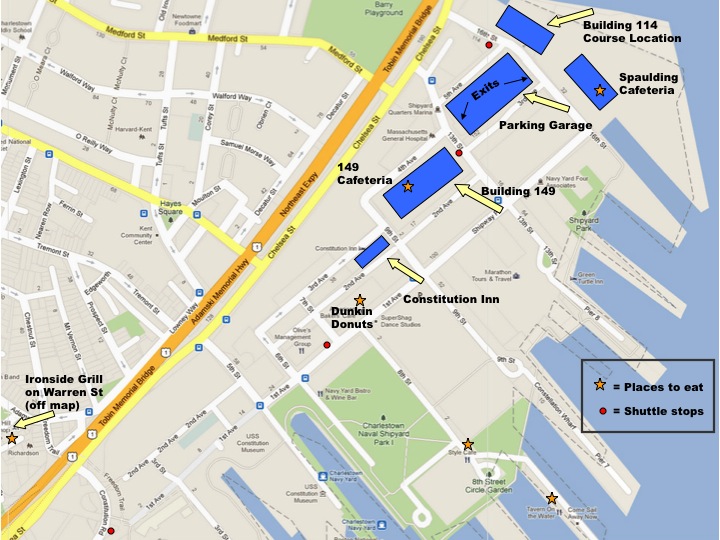
Public Transportation & Shuttle
If you are coming via the train (aka the T), there is a free Partners shuttle bus that picks you up at the North Station T stop (across from TD Banknorth Garden) and will take you to the course location in the Navy Yard. The shuttle schedule can be found here here under "MGH Main Campus, North Station, One Constitution Road, Charlestown Navy Yard". (Note: There is a second schedule in the list with a similar name but without "One Constitution Road" in the title. This is the Saturday/Sunday schedule. Be sure to choose the schedule that corresponds to the date you are traveling.)
From inside the train station, exit North Station to the Causeway Street exit. The shuttle stops right outside of the T stop in front of the CVS (near the lamp post on the leftin this picture). Note: CVS is not in the picture because it was not yet built when the picture was taken.
The shuttle comes every 15 minutes during the day (after 7pm, it comes every half hour and stops around 1am). It will arrive at North Station approximately 5 minutes after the time listed on the schedule under "Arrive/Depart MGH Main Campus". The shuttle stops right in front of Building 114 (the third stop after you board at North Station). Please see the map above for the shuttle bus stop and building location.
There is another shuttle bus that picks up from North Station. It has only one stop - the Spaulding Rehab building in the Navy Yard. This is right next to the course location. The Spaulding shuttle has a limited schedule and only operates between 6:00 AM - 9:00 AM and 3:00 PM - 6:00 PM on weekdays. On weekends, it does not operate in the evening. It runs approximately every 10 minutes.
Directions from Parking Garage
As can be seen on the map above, the parking garage has two exits. The exit at the back of the garage takes you to 16th Street and is closest to Building 114, however, it consists only of stairs. The exit farthest from Building 114 has elevators. If you would prefer to take an elevator, take it to the 1st floor. From there, go out the double doors and make a right. Take another right at the corner onto 5th Avenue. Cross the street at the crosswalk and in front of you will be the entrance to Building 114.