|
Size: 12207
Comment:
|
Size: 12606
Comment: now two links- back to course page (FsTutorial) and back to list of all tutorials (Tutorials)
|
| Deletions are marked like this. | Additions are marked like this. |
| Line 2: | Line 2: |
[[FreeSurferWiki|top]] | [[Tutorials|previous]]| [[FsFastTutorialV5.1|FSFAST Tutorial Top]] [[FsFastTutorialV5.1/TutorialData|A. FS-FAST Tutorial Data ]] <<BR>> [[FsFastTutorialV5.1/FsFastDirStruct|B. Understanding the FS-FAST Directory Structure]] <<BR>> [[FsFastTutorialV5.1/FsFastPreProc|C. FS-FAST Preprocessing]] <<BR>> [[FsFastTutorialV5.1/FsFastFirstLevel|D. FS-FAST First Level (Time Series) Analysis]] <<BR>> [[FsFastTutorialV5.1/FsFastGroupLevel|E. FS-FAST Group Analysis]] <<BR>> |
[[https://surfer.nmr.mgh.harvard.edu/fswiki/Tutorials|Back to list of all tutorials]] | [[FsTutorial|Back to course page]] | [[FsFastTutorialV5.1/FsFastPreProc|Previous (Preprocessing)]] | [[FsFastTutorialV5.1/FsFastGroupLevel|Next (Group Analysis)]] |
| Line 14: | Line 7: |
| In general, the group analysis for fMRI is very similar to that of the structural data. There is a tutorial for this at GroupAnalysis. There are several specific differences for fMRI which are described here. In the '''__structrual__''' GroupAnalysis, you would: |
In general, the group analysis for fMRI is very similar to that of the structural data. There is a tutorial for this at [[FsTutorial/GroupAnalysis|GroupAnalysis]]. There are several specific differences for fMRI which are described here. In the '''__structrual__''' [[FsTutorial/GroupAnalysis|Group Analysis]], you would: |
| Line 32: | Line 25: |
| Start the tutorial in the Project directory {{{ setenv SUBJECTS_DIR $TUTORIAL_DATA/fsfast-tutorial.subjects cd $TUTORIAL_DATA/fsfast-functional }}} |
|
| Line 33: | Line 32: |
| In the structural stream (see GroupAnalysis), the subject's data were concatenated into one file with mris_preproc . For the functional stream, the program is called isxconcat-sess: | In the structural stream (see [[FsTutorial/GroupAnalysis|GroupAnalysis]]), the subject's data were concatenated into one file with mris_preproc . For the functional stream, the program is called isxconcat-sess: |
| Line 43: | Line 42: |
| Line 48: | Line 46: |
| {{attachment:isxconcat.jpg|junk|width=700}} | {{attachment:isxconcat.jpg|junk|width="700"}} |
| Line 56: | Line 54: |
| Line 86: | Line 83: |
| Each of the volumes is in the output space (lh, rh, mni305), as can be verified with mri_info. |
Each of the volumes is in the output space (lh, rh, mni305), as can be verified with mri_info. |
| Line 102: | Line 98: |
| Details on how to run the GLM are given in GroupAnalysis, including the use of FSGD files to construct complicated group-level design matrices. Here we are going to use a very simple design in which test whether the mean across the groups equals 0 (the One Sample Group Mean, or OSGM). This just requires a design matrix with a single column of all ones (created with the --osgm flag): | Details on how to run the GLM are given in GroupAnalysis, including the use of FSGD files to construct complicated group-level design matrices. Here we are going to use a very simple design which tests whether the mean across the groups equals 0 (the One Sample Group Mean, or OSGM). This just requires a design matrix with a single column of all ones (created with the --osgm flag): |
| Line 123: | Line 119: |
| tksurfer fsaverage lh inflated -aparc -overlay my-glm.wls/osgm/sig.nii.gz -fminmax 2 5 | tksurferfv fsaverage lh inflated -aparc -overlay my-glm.wls/osgm/sig.nii.gz -fminmax 2 3 |
| Line 126: | Line 122: |
| * Threshold set to 2 (p<.01) | * -fminmax 2 3 : threshold set to 2 (p<.01), saturation to 3 (p<.001) |
| Line 140: | Line 137: |
| * Use positive contrast values * --cwpvalthresh .0166 : Cluster-wise p-value threshold. Only keep clusters that have p<.0166 Using a cluster-wise p-value threshold of p < .0166 corrects across all three spaces for p<.05 (ie, .0166 = .05/3). This corrections for a whole brain (ie, lh, rh, and subcortical) analysis. |
* Use positive contrast values * --cwpvalthresh .0166 : Cluster-wise p-value threshold. Only keep clusters that have p<.0166 Using a cluster-wise p-value threshold of p < .0166 corrects across all three spaces for p<.05 (ie, .0166 = .05/3). This corrections for a whole brain (ie, lh, rh, and subcortical) analysis. |
| Line 148: | Line 143: |
| Line 153: | Line 149: |
| View the left hemisphere [[FsFastGroupLevel/ClusterSummaryLh|cache.th30.pos.sig.cluster.summary]] table | View the left hemisphere [[FsFastGroupLevel/ClusterSummaryLh|cache.th30.pos.sig.cluster.summary]] table |
| Line 157: | Line 154: |
| Line 159: | Line 155: |
| {{{ tksurfer fsaverage lh inflated \ |
{{{ tksurferfv fsaverage lh inflated \ |
| Line 162: | Line 159: |
| -annot ./my-glm.wls/osgm/cache.th30.pos.sig.ocn.annot | -annot ./my-glm.wls/osgm/cache.th30.pos.sig.ocn.annot -fminmax 1.3 3 |
| Line 165: | Line 162: |
| Line 174: | Line 172: |
| mri_glmfit --y ces.nii.gz --wls cesvar.nii.gz --osgm --surface fsaverage rh --glmdir my-glm.wls --nii.gz | mri_glmfit --y ces.nii.gz --wls cesvar.nii.gz --osgm \ --surface fsaverage rh --glmdir my-glm.wls --nii.gz |
| Line 177: | Line 176: |
View the right hemisphere [[FsFastGroupLevel/ClusterSummaryRh|cache.th30.pos.sig.cluster.summary]] table |
View the right hemisphere [[FsFastGroupLevel/ClusterSummaryRh|cache.th30.pos.sig.cluster.summary]] table |
| Line 182: | Line 181: |
| Line 190: | Line 188: |
| This directory has the same files as the surface-based results, though their dimensions are different. All the volumes here are true volumes. The mri_glmfit command is the same as for the surface-based analysis but without the (--surface fsaverage lh) part and with the specification of a mask |
This directory has the same files as the surface-based results, though their dimensions are different. All the volumes here are true volumes. The mri_glmfit command is the same as for the surface-based analysis but without the (--surface fsaverage lh) part: |
| Line 198: | Line 194: |
| mri_glmfit --y ces.nii.gz --wls cesvar.nii.gz --osgm --glmdir my-glm.wls --nii.gz tkmedit fsaverage orig.mgz -aparc+aseg -overlay my-glm.wls/osgm/sig.nii.gz --fminmax 2 5 }}} {{attachment:mni.group.encode.cor128.jpg}}{{attachment:mni.group.encode.sag149.jpg}} |
mri_glmfit --y ces.nii.gz --wls cesvar.nii.gz --osgm \ --glmdir my-glm.wls --nii.gz tkmeditfv fsaverage orig.mgz -aparc+aseg -overlay my-glm.wls/osgm/sig.nii.gz -fminmax 2 3 }}} {{attachment:mni.group.encode.cor128.jpg}} {{attachment:mni.group.encode.sag149.jpg}} |
| Line 206: | Line 204: |
| * Voxel-wise threshold of 2 (p<.01) | * -fminmax 2 3 : Voxel-wise threshold of 2 (p<.01), color saturation at 3 (p<.001) |
| Line 209: | Line 207: |
| Line 215: | Line 214: |
| View the subcortical [[FsFastGroupLevel/ClusterSummaryMni305|grf.th3.pos.sig.cluster.summary]] table | View the subcortical [[FsFastGroupLevel/ClusterSummaryMni305|grf.th3.pos.sig.cluster.summary]] table |
| Line 222: | Line 222: |
| {{{ tkmedit fsaverage orig.mgz \ |
{{{ tkmeditfv fsaverage orig.mgz \ |
| Line 226: | Line 227: |
| ./my-glm.wls/osgm/grf.th3.pos.sig.ocn.lut | ./my-glm.wls/osgm/grf.th3.pos.sig.ocn.lut \ -fminmax 1.3 5 |
| Line 230: | Line 232: |
| * Set threshold to 1.3 (p<.05) | |
| Line 232: | Line 235: |
These three tables give you the clusters across the whole brain for [[FsFastGroupLevel/ClusterSummaryLh|Left Hemisphere]] [[FsFastGroupLevel/ClusterSummaryRh|Right Hemisphere]] [[FsFastGroupLevel/ClusterSummaryMni305|Subcortical]] |
These three tables give you the clusters across the whole brain for [[FsFastGroupLevel/ClusterSummaryLh|Left Hemisphere]] [[FsFastGroupLevel/ClusterSummaryRh|Right Hemisphere]] [[FsFastGroupLevel/ClusterSummaryMni305|Subcortical]] |
| Line 244: | Line 243: |
| Line 246: | Line 244: |
| Line 253: | Line 252: |
| Creates encode.merged.nii.gz by mapping the left and right hemispheres to the volume and merging with the subcotical results. |
Creates encode.merged.nii.gz by mapping the left and right hemispheres to the volume and merging with the subcotical results. |
| Line 257: | Line 255: |
| {{{ tkmedit fsaverage orig.mgz -aparc+aseg -ov junk.nii.gz -fminmax 1.3 5 }}} {{attachment:merged.group.encode.cor128.jpg}}{{attachment:merged.group.encode.cor095.jpg}}{{attachment:merged.group.encode.sag149.jpg}} |
{{{ tkmeditfv fsaverage orig.mgz -aparc+aseg -ov encode.merged.nii.gz -fminmax 1.3 5 -surfs }}} {{attachment:merged.group.encode.cor128.jpg}} {{attachment:merged.group.encode.cor095.jpg}} {{attachment:merged.group.encode.sag149.jpg}} |
| Line 265: | Line 264: |
| * Color indicates cluster p-value. | * Color indicates cluster p-value. |
| Line 270: | Line 269: |
[[https://surfer.nmr.mgh.harvard.edu/fswiki/Tutorials|Back to list of all tutorials]] | [[FsTutorial|Back to course page]] | [[FsFastTutorialV5.1/FsFastPreProc|Previous (Preprocessing)]] | [[FsFastTutorialV5.1/FsFastGroupLevel|Next (Group Analysis)]] |
Back to list of all tutorials | Back to course page | Previous (Preprocessing) | Next (Group Analysis)
Contents
1. Group Level Analysis
In general, the group analysis for fMRI is very similar to that of the structural data. There is a tutorial for this at GroupAnalysis. There are several specific differences for fMRI which are described here.
In the structrual Group Analysis, you would:
- Run mris_preproc to resample each subject into the common space and then concatenate all of your subjects (one subject for each frame) into one file.
- Smoothed the data on the surface, then
- Run mri_glmfit and mri_glmfit-sim
For the function MRI group analysis you will need to:
- Concatenate individuals into one file (isxconcat-sess)
- Do not smooth (already smoothed during first-level analysis)
- Run mri_glmfit using weighted least squares (WLS)
- Correct for multiple comparisons
- Perform the above in each space (lh, rh, and mni305)
- Correct for multiple comparisons across the three spaces
- Optionally merge the three spaces into one volume space
Start the tutorial in the Project directory
setenv SUBJECTS_DIR $TUTORIAL_DATA/fsfast-tutorial.subjects
cd $TUTORIAL_DATA/fsfast-functional
2. Concatenating the Data
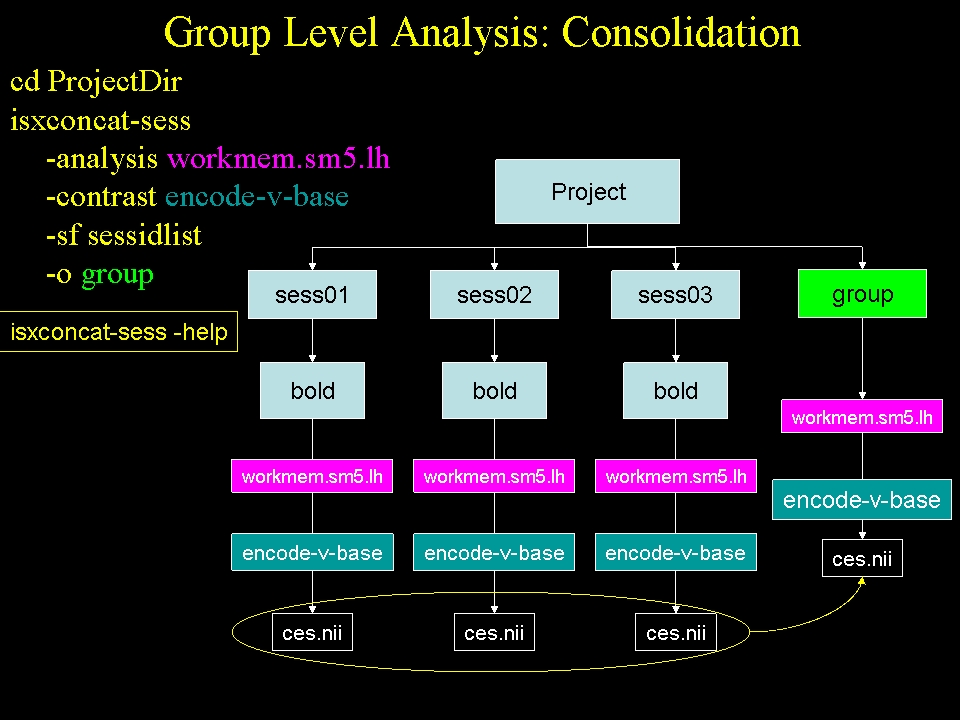
In the structural stream (see GroupAnalysis), the subject's data were concatenated into one file with mris_preproc . For the functional stream, the program is called isxconcat-sess:
isxconcat-sess -sf sessidlist -analysis workmem.sm05.lh -contrast encode-v-base -o my-group
- -sf sessidlist : use all the subjects listed in sessidlist (order is important!)
- -analysis workmem.sm05.lh : analysis from mkanalysis-sess and selxavg3-sess
- -contrast encode-v-base : contrast from mkcontrast-sess
- -o my-group : output folder is called 'my-group'
- Note: -all-contrasts can be used instead of -contrast
- Gets the contrast values (ces.nii.gz) for each subject and concatenates them into one file
- Does the same for the contrast variances (cesvar.nii.gz)
- Creates other files as well that can be used for checking for quality
Run the concatenation for the right hemisphere and mni305 spaces
isxconcat-sess -sf sessidlist -analysis workmem.sm05.rh -contrast encode-v-base -o my-group
isxconcat-sess -sf sessidlist -analysis workmem.sm05.mni305 -contrast encode-v-base -o my-group
When this is complete, a directory called 'my-group' will be created. cd into this directory and see what's there:
cd $TUTORIAL_DATA/fsfast-functional/my-group
ls
- grouplist.txt : list of the sessions
subjectlist.txt : list of the corresponding FreeSurfer subject IDs
- sess.info.txt : other information about each session
- workmem.sm05.lh - left hemisphere analysis output folder
- workmem.sm05.rh - right hemisphere analysis output folder
- workmem.sm05.mni305 - MNI 305 analysis output folder
Go into the workmem.sm05.lh and see what's there:
cd $TUTORIAL_DATA/fsfast-functional/my-group/workmem.sm05.lh
ls
You will see several files and folders:
- analysis.info - copy of the analysis.info created by mkanalysis-sess
- meanfunc.nii.gz - a stack of the mean functional images for each session
- masks.nii.gz - a stack of the masks of all the individual subjects
- mask.nii.gz - a single mask based on the intersection of all masks
- fsnr.nii.gz - a stack of the functional SNRs for each session
- ffxdof.dat - text file with the total number of DOF summed over all sessions
- encode-v-base - folder with lower-level contrasts for the group of sessions
Each of the volumes is in the output space (lh, rh, mni305), as can be verified with mri_info.
Go into the contrast folder and see what's there:
cd $TUTORIAL_DATA/fsfast-functional/group/workmem.sm05.lh/encode-v-base
ls
- Note: using 'group' instead of 'my-group'
- ces.nii.gz - stack of all the contrast values from the lower level, one for each session
- cesvar.nii.gz - stack of all the contrast variances from the lower level, one for each session
These are going to be the inputs for the group GLM analysis.
3. Run the Group GLM for the Left Hemisphere
Details on how to run the GLM are given in GroupAnalysis, including the use of FSGD files to construct complicated group-level design matrices. Here we are going to use a very simple design which tests whether the mean across the groups equals 0 (the One Sample Group Mean, or OSGM). This just requires a design matrix with a single column of all ones (created with the --osgm flag):
mri_glmfit --y ces.nii.gz \
  --wls cesvar.nii.gz \
  --osgm \
  --surface fsaverage lh \
  --glmdir my-glm.wls \
  --nii.gz
- --y ces.nii.gz : the input values to analyze
- --wls cesvar.nii.gz : variance weighting
- --osgm : use One-Sample Group Mean
- --surface fsaverage lh : indicates surface based data (not used for volume data)
- --glmdir my-glm.wls : output directory
- --nii.gz : use compressed NIFTI as output format
The one difference between this and the call in the structrual stream is the presence of the '--wls cesvar.nii.gz' option. cesvar.nii.gz is the variance of each session at each voxel. This is used to de-weight a session with high variance. This is not a true mixed effects analysis (this has been referred to as 'psuedo mixed effects'; see Thirion, 2007, Neuroimage). This step is not performed in the structural stream because we do not have variance information for each subject.
3.1. Visualize the Results of the Group GLM
tksurferfv fsaverage lh inflated -aparc -overlay my-glm.wls/osgm/sig.nii.gz -fminmax 2 3
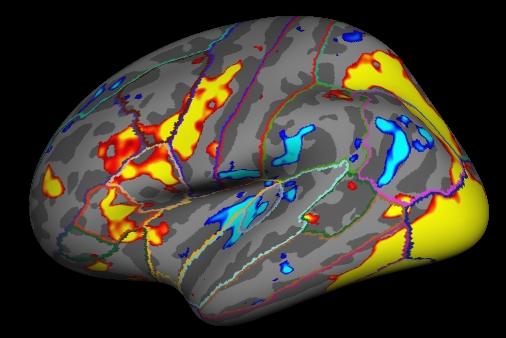
-fminmax 2 3 : threshold set to 2 (p<.01), saturation to 3 (p<.001)
- Uncorrected p-values
- Positve and negative values
3.2. Correct for Multiple Comparisons
The correction is the same as for the structural group analysis. For example, run:
mri_glmfit-sim --glmdir my-glm.wls --cache 3 pos --cwpvalthresh .0166
- --glmdir my-glm.wls : output from mri_glmfit command
- --cache 3 pos
- Use pre-cached simulation
Voxel-wise threshold of 3 (p<.001)
- Use positive contrast values
--cwpvalthresh .0166 : Cluster-wise p-value threshold. Only keep clusters that have p<.0166
Using a cluster-wise p-value threshold of p < .0166 corrects across all three spaces for p<.05 (ie, .0166 = .05/3). This corrections for a whole brain (ie, lh, rh, and subcortical) analysis.
This will create several outputs, though there are three that are most important:
- cache.th30.pos.sig.cluster.summary - cluster summary table (simple ASCII text)
- cache.th30.pos.sig.cluster.nii.gz - overlay with significant clusters
- cache.th30.pos.ocn.annot - annotation of significant clusters
- Name indicates how correction was done (cache, thresh = 3, pos sign)
View the left hemisphere cache.th30.pos.sig.cluster.summary table
cat my-glm.wls/osgm/cache.th30.pos.sig.cluster.summary
View the clusters on the surface
tksurferfv fsaverage lh inflated \
  -overlay my-glm.wls/osgm/cache.th30.pos.sig.cluster.nii.gz \
  -annot ./my-glm.wls/osgm/cache.th30.pos.sig.ocn.annot -fminmax 1.3 3
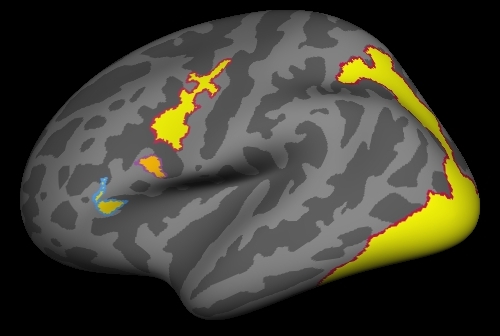
All clusters are whole-brain corrected at p<.05
- All positive because only positive was selected.
- Annotation gives cluster number
4. Right Hemisphere
Perform the same operations above for the right hemisphere (ie, go into workmem.sm05.rh):
cd $TUTORIAL_DATA/fsfast-functional/group/workmem.sm05.rh/encode-v-base
mri_glmfit --y ces.nii.gz --wls cesvar.nii.gz --osgm \
  --surface fsaverage rh --glmdir my-glm.wls --nii.gz
mri_glmfit-sim --glmdir my-glm.wls --cache 3 pos --cwpvalthresh .0166
View the right hemisphere cache.th30.pos.sig.cluster.summary table
cat my-glm.wls/osgm/cache.th30.pos.sig.cluster.summary
5. Subcortical (MNI 305 Space)
Perform the same operations above for the MNI 305 space analysis (ie, go into workmem.sm05.mni305). There are a couple of things that are different about this analysis.
cd $TUTORIAL_DATA/fsfast-functional/group/workmem.sm05.mni305/encode-v-base
ls
This directory has the same files as the surface-based results, though their dimensions are different. All the volumes here are true volumes.
The mri_glmfit command is the same as for the surface-based analysis but without the (--surface fsaverage lh) part:
cd $TUTORIAL_DATA/fsfast-functional/group/workmem.sm05.mni305/encode-v-base
mri_glmfit --y ces.nii.gz --wls cesvar.nii.gz --osgm  \
  --glmdir my-glm.wls --nii.gz
tkmeditfv fsaverage orig.mgz -aparc+aseg -overlay my-glm.wls/osgm/sig.nii.gz -fminmax 2 3
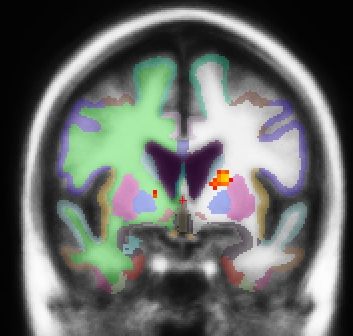
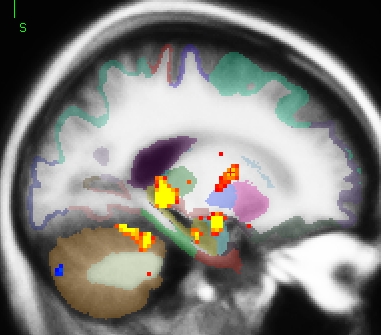
- Left image is coronal slice 128
- Right image is sagittal slice 149
- No activation in cortical areas
- Positive and negative uncorrected p-values
-fminmax 2 3 : Voxel-wise threshold of 2 (p<.01), color saturation at 3 (p<.001)
To correct the subcortical analysis for multiple comparisons run:
mri_glmfit-sim --glmdir my-glm.wls --grf 3 pos --cwpvalthresh .0166
- As with the surface-based analysis, a summary file is created called grf.th3.pos.sig.cluster.summary
- Creates grf.th3.pos.sig.ocn.anat.nii.gz and grf.th3.pos.sig.ocn.lut. These are segmentations of the clusters.
View the subcortical grf.th3.pos.sig.cluster.summary table
cat my-glm.wls/osgm/grf.th3.pos.sig.cluster.summary
There are five clusters for the subcortical analysis.
View the corrected results in the volume:
tkmeditfv fsaverage orig.mgz \
  -ov my-glm.wls/osgm/grf.th3.pos.sig.cluster.nii.gz \
  -seg ./my-glm.wls/osgm/grf.th3.pos.sig.ocn.anat.nii.gz  \
       ./my-glm.wls/osgm/grf.th3.pos.sig.ocn.lut \
-fminmax 1.3 5- Only positive values
- p-values are p-values for cluster
Set threshold to 1.3 (p<.05)
6. Merging the Results
These three tables give you the clusters across the whole brain for Left Hemisphere Right Hemisphere Subcortical
cd $TUTORIAL_DATA/fsfast-functional/group
cat workmem.sm05.lh/encode-v-base/my-glm.wls/osgm/cache.th30.pos.sig.cluster.summary
cat workmem.sm05.rh/encode-v-base/my-glm.wls/osgm/cache.th30.pos.sig.cluster.summary
cat workmem.sm05.mni305/encode-v-base/my-glm.wls/osgm/grf.th3.pos.sig.cluster.summary
Merge the corrected results into a single volume for visualization
vlrmerge --o encode.merged.nii.gz \
  --lh workmem.sm05.lh/encode-v-base/my-glm.wls/osgm/cache.th30.pos.sig.cluster.nii.gz \
  --rh workmem.sm05.rh/encode-v-base/my-glm.wls/osgm/cache.th30.pos.sig.cluster.nii.gz \
  --vol workmem.sm05.mni305/encode-v-base/my-glm.wls/osgm/grf.th3.pos.sig.cluster.nii.gz \
  --scm workmem.sm05.mni305/subcort.mask.nii.gz
Creates encode.merged.nii.gz by mapping the left and right hemispheres to the volume and merging with the subcotical results.
View the merged volume
tkmeditfv fsaverage orig.mgz -aparc+aseg -ov encode.merged.nii.gz -fminmax 1.3 5 -surfs
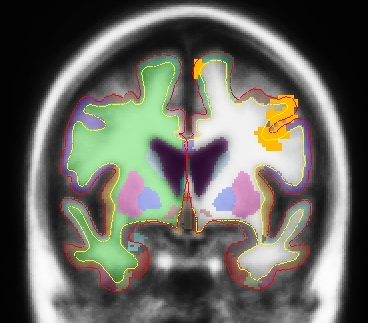
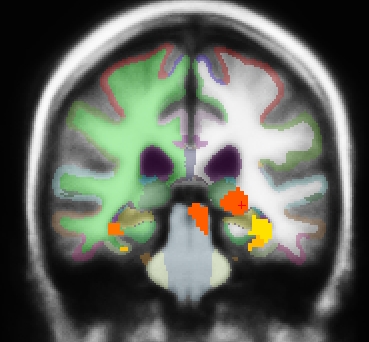
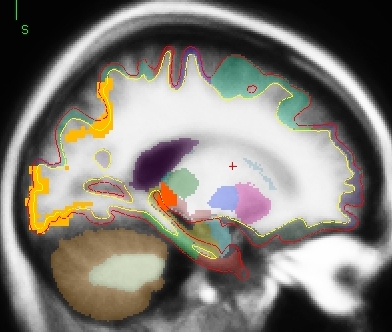
- Left image is coronal slice 128
- Middle image is coronal slice 95
- Right image is sagittal slice 149
- Color indicates cluster p-value.
- All positive because only positive was selected.
- Cortical activation comes from the cortical analysis
- Subcortical activation comes from the subcortical analysis
All activation in this image has been corrected for whole-brain multiple comparisons a p<.05.
Back to list of all tutorials | Back to course page | Previous (Preprocessing) | Next (Group Analysis)