|
Size: 1352
Comment:
|
← Revision 55 as of 2015-09-28 10:20:19 ⇥
Size: 2738
Comment:
|
| Deletions are marked like this. | Additions are marked like this. |
| Line 1: | Line 1: |
| == FreeSurfer Tutorial Dataset == | == FreeSurfer Tutorial Data set == |
| Line 3: | Line 3: |
| Download the freesurfer tutorial data set using any of the following methods: | Follow the instructions below for running the [[FsTutorial|FreeSurfer tutorials]]. These instruction are valid for both Mac OSX and Linux platforms (!FreeSurfer is not available on Windows platform). |
| Line 5: | Line 5: |
| * Click the following link: ftp://surfer.nmr.mgh.harvard.edu/pub/data/tutorial_data.tar.gz |
''Please note, some experience with the command line (Terminal) is required to successfully install and run !FreeSurfer. If you do not have previous experience with the command line, and you are setting up your computer in preparation for the !FreeSurfer course, it is probably best to simply attempt to install !FreeSurfer, and download the tutorial data onto your machine, then wait till after the first !FreeSurfer course presentation [[http://surfer.nmr.mgh.harvard.edu/pub/docs/unix_jargon_ani.ppt|Unix Tutorial for FreeSurfer Users]] until you start running the tutorials on your own machine.'' |
| Line 8: | Line 7: |
| * On Mac OSX platforms use 'curl -O' {{{curl -O ftp://surfer.nmr.mgh.harvard.edu/pub/data/tutorial_data.tar.gz}}} |
=== 1. Install FreeSurfer === |
| Line 11: | Line 9: |
| * On Linux platforms use 'wget' {{{wget ftp://surfer.nmr.mgh.harvard.edu/pub/data/tutorial_data.tar.gz}}} |
The first step is to install !FreeSurfer on your personal machine. To install !FreeSurfer, follow the instructions on [[https://surfer.nmr.mgh.harvard.edu/fswiki/DownloadAndInstall|the download and installation page]]. ''Please note, the tutorials require users to have the "development version" of !FreeSurfer installed. So when it comes time to select the version for download do NOT select version 5.3, download the "development version" instead, which can be found [[ftp://surfer.nmr.mgh.harvard.edu/pub/dist/freesurfer/dev/|on this page]].'' |
| Line 15: | Line 15: |
| === 2. Download tutorial data === | |
| Line 16: | Line 17: |
| Once !FreeSurfer is installed, it is time to download the tutorial data set: | |
| Line 17: | Line 19: |
| [[ftp://surfer.nmr.mgh.harvard.edu/pub/data/tutorial_data.tar.gz|tutorial_data.tar.gz]]. | |
| Line 18: | Line 21: |
| '''''REMEMBER THE LOCATION OF THE EXTRACTED CONTENTS''''', you will need to set an an environment variable called '''TUTORIAL_DATA''', set to this this directory, in order to do the tutorials. Its content should look as follows: | |
| Line 19: | Line 23: |
| The data for the [[FsTutorial| tutorials]] consists of several data sets: * buckner_data-tutorial_subjs.tar.gz: the main 'recon-all' stream subject data processing (size: ~16GB uncompressed)[[ftp://surfer.nmr.mgh.harvard.edu/pub/data/buckner_data-tutorial_subjs.md5sum.txt|Here is the md5sum]]. * long-tutorial.tar.gz: the longitudinal tutorial (size: ~16GB uncompressed) * fsfast-tutorial.subjects.tar.gz & fsfast-functional.tar.gz: the FS-FAST tutorial data set (size: ~5.6GB uncompressed & ~9.1GB uncompressed, respectively) * diffusion_recons.tar.gz & diffusion_tutorial.tar.gz - the diffusion and Tracula tutorial data sets * fbert-feat.tgz & bert.recon.tgz - tutorial on the integration of !FreeSurfer and FSL/FEAT |
{{attachment:finder.png}} |
| Line 26: | Line 25: |
| If you only want to get started with the basics of !FreeSurfer, you need only download the buckner_data set. This will allow you to do the following tutorials: | === 3. Configure your system === Configuring your !FreeSurfer installation for the tutorials requires one simple step, sourcing !FreeSurfer and setting the '''TUTORIAL_DATA''' environment variable (setting it to the location of the extracted file from above). Continuing with the example from above, the steps below show the commands to type AFTER sourcing !FreeSurfer. If you type the {{{ls $TUTORIAL_DATA}}} command and see the directories extracted in step #2, you are ready to begin the [[FsTutorial|FreeSurfer tutorials]]. {{{ $> <source freesurfer> $> export TUTORIAL_DATA=/Users/localzeke/Downloads/tutorial_data $> ls $TUTORIAL_DATA buckner_data fsfast-functional diffusion_recons fsfast-tutorial.subjects diffusion_tutorial long-tutorial }}} {{attachment:Screen Shot 2015-08-24 at 4.56.51 PM.png}} |
FreeSurfer Tutorial Data set
Follow the instructions below for running the FreeSurfer tutorials. These instruction are valid for both Mac OSX and Linux platforms (FreeSurfer is not available on Windows platform).
Please note, some experience with the command line (Terminal) is required to successfully install and run FreeSurfer. If you do not have previous experience with the command line, and you are setting up your computer in preparation for the FreeSurfer course, it is probably best to simply attempt to install FreeSurfer, and download the tutorial data onto your machine, then wait till after the first FreeSurfer course presentation Unix Tutorial for FreeSurfer Users until you start running the tutorials on your own machine.
1. Install FreeSurfer
The first step is to install FreeSurfer on your personal machine. To install FreeSurfer, follow the instructions on the download and installation page.
Please note, the tutorials require users to have the "development version" of FreeSurfer installed. So when it comes time to select the version for download do NOT select version 5.3, download the "development version" instead, which can be found on this page.
2. Download tutorial data
Once FreeSurfer is installed, it is time to download the tutorial data set:
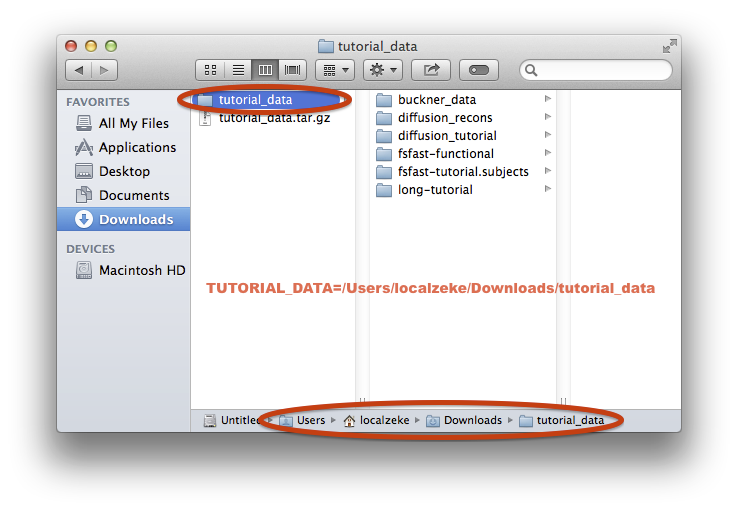
REMEMBER THE LOCATION OF THE EXTRACTED CONTENTS, you will need to set an an environment variable called TUTORIAL_DATA, set to this this directory, in order to do the tutorials. Its content should look as follows:
3. Configure your system
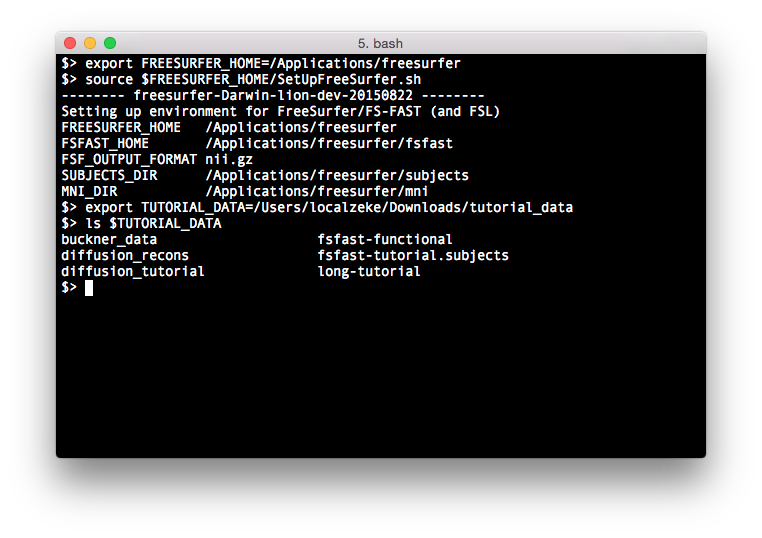
Configuring your FreeSurfer installation for the tutorials requires one simple step, sourcing FreeSurfer and setting the TUTORIAL_DATA environment variable (setting it to the location of the extracted file from above). Continuing with the example from above, the steps below show the commands to type AFTER sourcing FreeSurfer. If you type the ls $TUTORIAL_DATA command and see the directories extracted in step #2, you are ready to begin the FreeSurfer tutorials.
$> <source freesurfer>
$> export TUTORIAL_DATA=/Users/localzeke/Downloads/tutorial_data
$> ls $TUTORIAL_DATA
buckner_data                    fsfast-functional
diffusion_recons                fsfast-tutorial.subjects
diffusion_tutorial              long-tutorial