|
Size: 7002
Comment:
|
← Revision 26 as of 2016-09-23 10:26:15 ⇥
Size: 9071
Comment: changed organized course command to bash since course laptops now run bash instead of tcsh
|
| Deletions are marked like this. | Additions are marked like this. |
| Line 1: | Line 1: |
| [wiki:Self:FsTutorial top] | [wiki:Self:FsTutorial/FslFeatFreeSurfer previous] == Overlaying FSL Feat statistical maps and Higher-Level Analysis == |
[[https://surfer.nmr.mgh.harvard.edu/fswiki/Tutorials|Back to list of all tutorials]]<<BR>>[[https://surfer.nmr.mgh.harvard.edu/fswiki/FsTutorial|Back to course page]]<<BR>>[[https://surfer.nmr.mgh.harvard.edu/fswiki/FsTutorial/FslFeatFreeSurfer|FslFeat Tutorial Homepage]] |
| Line 4: | Line 3: |
| *To follow this exercise exactly be sure you've downloaded the [wiki:Self:FsTutorial/Data tutorial data set] before you begin. If you choose not to download the data set you can follow these instructions on your own data, but you will have to substitute your own specific paths and subject names. | ---- |
| Line 6: | Line 5: |
| In this exercise, the data set of subject '''bert''' is used for demonstration. To begin the exercises, first enter the following directory, and then set the current directory to be the default subjects directory using this command: | == Surface-based Group Analysis == === Preparations === ==== If You're at an Organized Course ==== If you are taking one of the formally organized courses, everything has been set up for you on the provided laptop. The only thing you will need to do is run the following commands in ''every'' '''new''' terminal window (aka shell) you open throughout this tutorial. Copy and paste the commands below to get started: |
| Line 8: | Line 11: |
| cd $FREESURFER_HOME/subjects/buckner_data/tutorial_subjs setenv SUBJECTS_DIR ${PWD} |
export SUBJECTS_DIR=$TUTORIAL_DATA/buckner_data/tutorial_subjs cd $SUBJECTS_DIR/fbert-feat ln -s $FREESURFER_HOME/subjects/fsaverage ln -s $FREESURFER_HOME/subjects/bert |
| Line 11: | Line 16: |
| ''To copy: Highlight the command in the box above, right click and select copy (or use keyboard shortcut Ctrl+c), then use the middle button of your mouse to click inside the terminal window (this will paste the command). Press enter to run the command.'' | |
| Line 12: | Line 18: |
| === 1.0 Overlaying the statistical map onto the bert's orig volume === | These two commands set the SUBJECTS_DIR variable to the directory where the data is stored and then navigates into this directory. You can now skip ahead to the tutorial (below the gray line). |
| Line 14: | Line 20: |
| Use the following command to display the zmap (zstat1.nii.gz) from the first run overlaid onto the bert's orig volume. It will display the automatic segmentation, and will also set the threshold at z = 2.3: | The subjects 'fsaverage' and 'bert' may already exist in the subjects directory, so ignore any warnings that might be issued that say 'File exists'. ==== If You're not at an Organized Course ==== If you are '''NOT''' taking one of the formally organized courses, then to follow this exercise exactly be sure you've downloaded the [[https://surfer.nmr.mgh.harvard.edu/fswiki/FsTutorial/Data|tutorial data set]] before you begin. If you choose not to download the data set you can follow these instructions on your own data, but you will have to substitute your own specific paths and subject names. These are the commands that you need to run before getting started: |
| Line 16: | Line 26: |
| tkmedit bert orig.mgz lh.white -aux brain.mgz \ -overlay ./fbert1.feat/stats/zstat1.nii.gz \ -overlay-reg ./fbert1.feat/reg/freesurfer/anat2exf.register.dat \ -segmentation aparc+aseg.mgz -fthresh 2.3 -fmax 4.3 |
## bash <source_freesurfer> export TUTORIAL_DATA=<path_to_your_tutorial_data> export SUBJECTS_DIR=$TUTORIAL_DATA/buckner_data/tutorial_subjs cd $SUBJECTS_DIR/fbert-feat ln -s $FREESURFER_HOME/subjects/fsaverage ln -s $FREESURFER_HOME/subjects/bert ## csh source your_freesurfer_dir/SetUpFreeSurfer.csh setenv TUTORIAL_DATA <path_to_your_tutorial_data> setenv SUBJECTS_DIR $TUTORIAL_DATA/buckner_data/tutorial_subjs cd $SUBJECTS_DIR/fbert-feat ln -s $FREESURFER_HOME/subjects/fsaverage ln -s $FREESURFER_HOME/subjects/bert |
| Line 21: | Line 42: |
| ''Information on how to source [[https://surfer.nmr.mgh.harvard.edu/fswiki/FreeSurfer|FreeSurfer]] is located [[https://surfer.nmr.mgh.harvard.edu/fswiki/DownloadAndInstall#Setup+&+Configuration|here]]''. | |
| Line 22: | Line 44: |
| You should see the image below:[[BR]] attachment:tkm-zstat1-cor-128.th23.small.jpg[[BR]] When you click or mouse over a voxel, the cortical or subcortical structure that that voxel belongs to will be displayed in the control panel. You can view any of the volumes in the stats dir in this way as well as the clustered maps in the feat directory. |
If you are not using the tutorial data you should set your {{{SUBJECTS_DIR}}} to the directory in which the recon(s) of the subject(s) you will use for this tutorial are located. |
| Line 26: | Line 46: |
| === 2.0 View statistical maps on bert's surface === To view any of the statistical maps on bert's surface, close the tkmedit GUI (or open a new terminal window) and run: |
The subjects 'fsaverage' and 'bert' may already exist in the subjects directory, so ignore any warnings that might be issued that say 'File exists'. -------- === 1.0 Resampling COPEs to common surface === === 1.1 Individual Runs for a Subject === In order to perform surface-based group analysis, you need to have all the copes sampled into a common space. This is done with mris_preproc: ---- |
| Line 29: | Line 56: |
| tksurfer bert lh inflated \ -overlay ./fbert1.feat/stats/zstat1.nii.gz \ -overlay-reg ./fbert1.feat/reg/freesurfer/anat2exf.register.dat \ -fthresh 2.3 -fmid 3.3 -fslope 1 -annot aparc.annot |
mris_preproc --target fsaverage --hemi lh --fwhm 5 \ --out xrun/lh.cope1.mgh \ --iv fbert1.feat/stats/cope1.nii.gz fbert1.feat/reg/freesurfer/anat2exf.register.dat \ --iv fbert2.feat/stats/cope1.nii.gz fbert2.feat/reg/freesurfer/anat2exf.register.dat |
| Line 34: | Line 61: |
| ---- In this case, the common space is the left hemisphere of fsaverage. Surface-based smoothing of 5mm FWHM is used. The output lh.cope1.mgh looks like a volume because it is in mgh format, but it is really a surface stored in a volume format (note it's dimensions are 1974 x 1 x 83 = 163842 = number of vertices in fsaverage's surface). It has 2 frames, one for each run. |
|
| Line 35: | Line 64: |
| Change the cortical parcellation to outline mode with View->LabelStyle->Outline. You should see the image below:[[BR]] attachment:tks-zstat1-rh-lat.th23.small.jpg [[BR]] When you click or mouse over a vertex, the control panel will display the name of the cortical structure. You can view any of the volumes in the stats dir in this way as well as the clustered maps in the feat directory. You can also run the tkmedit and tksurfer commands above in separate shells and use the Save-Point/Goto-Point functionality to navigate through the volume and surface. |
Note that each volume (cope1.nii.gz) is accompanied by a registration matrix (anat2exf.register.dat). The above example extracts data from each run of the same subject. If you have multiple subjects, you can specify the gfeat/cope1/stats/cope1.nii.gz paired with the anat2std.register.dat matrix. |
| Line 40: | Line 66: |
| === 3.0 Displaying Same-Subject, Cross-Run GFEAT Results === | You can also extract the cope variances (varcopes) in the same way: |
| Line 42: | Line 68: |
| Typically, one collects more than one run/series of functtional data for each subject. The individual runs are analyzed separately, then combined in standard space with GFEAT using a fixed-effects model. Since the data are no longer in the subject's native functional space, a different registration matrix is needed to map the GFEAT results to the individual. Each run of reg-feat2anat will create a reg/freesurfer/anat2std.register.dat. Any one of these can be used to map the GFEAT data to the subject's anatomy. |
---- {{{ mris_preproc --target fsaverage --hemi lh --fwhm 5 \ --out xrun/lh.varcope1.mgh \ --iv fbert1.feat/stats/varcope1.nii.gz fbert1.feat/reg/freesurfer/anat2exf.register.dat \ --iv fbert2.feat/stats/varcope1.nii.gz fbert2.feat/reg/freesurfer/anat2exf.register.dat }}} ---- === 1.2 Runs combined in a GFEAT within a Subject === Once the runs are combined in a GFEAT analysis, they are no longer in the native functional space but rather in the standard space. You can still use the surface-based analysis as long as the subjects have not been combined together. To do this, you just need the appropriate registration matrix that takes the data from standard space to the subject's anatomical. This is computed when you run reg-feat2anat. Each run will have this matrix, but they should all be the same. Eg: |
| Line 51: | Line 79: |
| First, verify that the registration is good with: | |
| Line 53: | Line 80: |
| tkregister2 --mov fbert.gfeat/mean_func.nii.gz --surf \ --reg fbert1.feat/reg/freesurfer/anat2std.register.dat |
mris_preproc --target fsaverage --hemi lh --fwhm 5 \ --out xsubject/lh.cope1.mgh \ --iv fbert.gfeat/cope1.feat/stats/cope1.nii.gz fbert1.feat/reg/freesurfer/anat2std.register.dat \ --iv fnick.gfeat/cope1.feat/stats/cope1.nii.gz fnick1.feat/reg/freesurfer/anat2std.register.dat \ ... |
| Line 56: | Line 86: |
| mean_func.nii.gz is the mean of the example_func's in standard space. | The cope is specified from the gfeat, but the registration matrix is specified from the feat from the first run of each subject. The output can be used in the surface-based group analysis below. |
| Line 58: | Line 88: |
| === 2.0 Surface-based Group Analysis (Fixed Effects) === Once you have the copes in the common surface space, the (nearly) same as you would with a thickness study. With a functional study, you also have the flexibility to run fixed- and weighted random-effects analysis. |
|
| Line 59: | Line 91: |
| Now show gfeat results on anatomical volume: | The command below can be used to run a fixed-effects analysis across both runs. Normally, you would probably run a random effects or weight random effects analysis, but since we only have two runs here, we'll use a fixed-effects. The dof=163 is the sum of the dofs from fbert?.feat/stats/dof. The model here is a simple one-sample group mean (OSGM) in which the design matrix is simply a column of 1s. For more elaborate designs, use an FSGD file instead of --osgm. ---- |
| Line 61: | Line 95: |
| tkmedit bert orig.mgz -seg aparc+aseg.mgz \ -ov fbert.gfeat/cope1.feat/stats/zstat1.nii.gz \ -ovreg fbert1.feat/reg/freesurfer/anat2std.register.dat \ -fthresh 2.3 -fmax 4.3 |
mri_glmfit --y xrun/lh.cope1.mgh --yffxvar xrun/lh.varcope1.mgh --ffxdof 163 \ --osgm --glmdir xrun/lh.osgm.ffx --surf fsaverage lh \ --label $SUBJECTS_DIR/fsaverage/label/lh.cortex.label |
| Line 66: | Line 99: |
| Here we've used the anat2std.register.dat from the first run. | ---- This will create a directory called xrun/lh.osgm.ffx: |
| Line 68: | Line 102: |
| Now show gfeat results on the surface: | |
| Line 70: | Line 103: |
| tksurfer bert lh inflated -annot aparc.annot \ -ov fbert.gfeat/cope1.feat/stats/zstat1.nii.gz \ -ovreg fbert1.feat/reg/freesurfer/anat2std.register.dat \ -fthresh 2.3 -fmid 3.3 -fslope 1 |
ls xrun/lh.osgm.ffx ar1.mgh -- spatial AR1 map beta.mgh -- regression coefficients (same as PEs) fwhm.dat -- estimate of spatial FWHM (not valid with 2 data points) mask.mgh -- binary mask (if used) mri_glmfit.log -- log file osgm -- contrast directory rstd.mgh -- residual standard deviation rvar.mgh -- residual standard variance Xg.dat -- design matrix (text) X.mat -- design matrix (matlab) |
| Line 75: | Line 115: |
| The most important results are in the contrast directory: | |
| Line 76: | Line 117: |
| === 3.0 Resampling COPEs to common surface and Higher-Level Analysis === | {{{ ls xrun/lh.osgm.ffx/osgm C.dat - contrast matrix cnr.mgh - contrast-to-noise ratio F.mgh - F ratio gamma.mgh - contrast size (same as COPE) maxvox.dat - info about the vertex with max F stat sig.mgh - significance map (-log10(p)) }}} To view the higher-level results, run: |
| Line 78: | Line 128: |
| When performing surface-based group analysis of functional data, the COPEs must be sampled to the common surface space (similar to how you must reslice the COPEs from the native functional space into standard space prior to group analysis). The surface sampling can be done in two ways. | ---- {{{ tksurfer fsaverage lh inflated \ -overlay xrun/lh.osgm.ffx/osgm/sig.mgh \ -fthresh 2 -fmid 3 -fslope 1 -annot aparc.annot }}} ---- There are several differences between this invocation of tksurfer and the one used during the individual analysis before: |
| Line 80: | Line 137: |
| First, you can use feat2surf as in: | * The subject is fsaverage, not bert * The input is a sig map, which is -log10(p) * The thresholds are significance thresholds, not z. So, 2 means p < .01. === 3.0 Alternative method to resample COPEs to common surface === This command will resample the copes to the common surface space, but does not concatenate them together as mris_preproc does. Rather, it stores the result in fbert1.feat/reg_surf-lh-fsaverage/stats for the left (reg_surf-rh-fsaverage for right). |
| Line 84: | Line 147: |
| This will create fbert.feat/reg_surf-lh-fsaverage/stats for the left hemi (and another for the right). There will be cope1.nii.gz. This looks like a volume because it is in nifti format, but it is really a surface stored in a volume format (note it's dimensions are 1974 x 1 x 83 = 163842 = number of vertices in fsaverage's surface). You can then concatenate these files from different subjects to perform group analysis with FreeSurfer's mri_glmfit or FSL's randomise or flame. Alternatively, when you have multiple runs/subjects, you can use mris_preproc, something like: {{{ mris_preproc --target fsaverage --hemi lh --out xrun/lh.cope1.nii.gz \ --iv fbert1.feat/stats/cope1.nii.gz fbert1.feat/reg/freesurfer/anat2exf.register.dat \ --iv fbert2.feat/stats/cope1.nii.gz fbert2.feat/reg/freesurfer/anat2exf.register.dat }}} This will create the output directory (xrun) and lh.cope1.nii.gz, the copes from each run sampled onto the left hemi of the common surface. In this case it will have only two frames for the two runs. This can then be used as input mri_glmfit, randomise, or flame. You can also resample the variances of the copes with: {{{ mris_preproc --target fsaverage --hemi lh --out xrun/lh.varcope1.nii.gz \ --iv fbert1.feat/stats/varcope1.nii.gz fbert1.feat/reg/freesurfer/anat2exf.register.dat \ --iv fbert2.feat/stats/varcope1.nii.gz fbert2.feat/reg/freesurfer/anat2exf.register.dat }}} The command below can be used to run a fixed-effects analysis across both runs. Normally, you would probably run a random effects or weight random effects analysis, but since we only have two runs here, we'll use a fixed-effects. The dof=163 is the sum of the dofs from fbert?.feat/stats/dof. The model here is a simple one-sample group mean (OSGM) in which the desgin matrix is simply a column of 1s. For more elaborate designs, use an FSGD file instead of --osgm. |
=== 4.0 Surface-based Group Analysis (Random Effects) === Usually, you will have many subjects and will want to run a random effects analysis. To do this, stack your subjects into one file (lh.cope1.mgh below) using mris_preproc or mri_concat and run the command below: |
| Line 105: | Line 151: |
| mri_glmfit --y xrun/lh.cope1.nii.gz --yffxvar xrun/lh.varcope1.nii.gz --ffxdof 163 \ --osgm --glmdir xrun/lh.osgm.ffx --surf fsaverage lh --label lh.cortex.label |
mri_glmfit --y lh.cope1.mgh \ --osgm --glmdir lh.osgm.rfx --surf fsaverage lh \ --label $SUBJECTS_DIR/fsaverage/label/lh.cortex.label |
| Line 108: | Line 155: |
| To view the higher-level results, run: {{{ tksurfer fsaverage lh inflated -overlay xrun/lh.osgm.ffx/osgm/sig.mgh \ -fthresh 4 -fmid 5 -fslope 1 -annot aparc.annot }}} There are several differences between this invokation of tksurfer and the one further above. * The subject is fsaverage, not bert * The input is a sig map, which is -log10(p) * The thresholds are significance thresholds, not z. So, 4 means p < .0001. |
---- [[https://surfer.nmr.mgh.harvard.edu/fswiki/Tutorials|Back to list of all tutorials]]<<BR>>[[https://surfer.nmr.mgh.harvard.edu/fswiki/FsTutorial|Back to course page]]<<BR>>[[https://surfer.nmr.mgh.harvard.edu/fswiki/FsTutorial/FslFeatFreeSurfer|FslFeat Tutorial Homepage]] |
Back to list of all tutorials
Back to course page
FslFeat Tutorial Homepage
Surface-based Group Analysis
Preparations
If You're at an Organized Course
If you are taking one of the formally organized courses, everything has been set up for you on the provided laptop. The only thing you will need to do is run the following commands in every new terminal window (aka shell) you open throughout this tutorial. Copy and paste the commands below to get started:
export SUBJECTS_DIR=$TUTORIAL_DATA/buckner_data/tutorial_subjs cd $SUBJECTS_DIR/fbert-feat ln -s $FREESURFER_HOME/subjects/fsaverage ln -s $FREESURFER_HOME/subjects/bert
To copy: Highlight the command in the box above, right click and select copy (or use keyboard shortcut Ctrl+c), then use the middle button of your mouse to click inside the terminal window (this will paste the command). Press enter to run the command.
These two commands set the SUBJECTS_DIR variable to the directory where the data is stored and then navigates into this directory. You can now skip ahead to the tutorial (below the gray line).
The subjects 'fsaverage' and 'bert' may already exist in the subjects directory, so ignore any warnings that might be issued that say 'File exists'.
If You're not at an Organized Course
If you are NOT taking one of the formally organized courses, then to follow this exercise exactly be sure you've downloaded the tutorial data set before you begin. If you choose not to download the data set you can follow these instructions on your own data, but you will have to substitute your own specific paths and subject names. These are the commands that you need to run before getting started:
## bash <source_freesurfer> export TUTORIAL_DATA=<path_to_your_tutorial_data> export SUBJECTS_DIR=$TUTORIAL_DATA/buckner_data/tutorial_subjs cd $SUBJECTS_DIR/fbert-feat ln -s $FREESURFER_HOME/subjects/fsaverage ln -s $FREESURFER_HOME/subjects/bert ## csh source your_freesurfer_dir/SetUpFreeSurfer.csh setenv TUTORIAL_DATA <path_to_your_tutorial_data> setenv SUBJECTS_DIR $TUTORIAL_DATA/buckner_data/tutorial_subjs cd $SUBJECTS_DIR/fbert-feat ln -s $FREESURFER_HOME/subjects/fsaverage ln -s $FREESURFER_HOME/subjects/bert
Information on how to source FreeSurfer is located here.
If you are not using the tutorial data you should set your SUBJECTS_DIR to the directory in which the recon(s) of the subject(s) you will use for this tutorial are located.
The subjects 'fsaverage' and 'bert' may already exist in the subjects directory, so ignore any warnings that might be issued that say 'File exists'.
1.0 Resampling COPEs to common surface
1.1 Individual Runs for a Subject
In order to perform surface-based group analysis, you need to have all the copes sampled into a common space. This is done with mris_preproc:
mris_preproc --target fsaverage --hemi lh --fwhm 5 \ --out xrun/lh.cope1.mgh \ --iv fbert1.feat/stats/cope1.nii.gz fbert1.feat/reg/freesurfer/anat2exf.register.dat \ --iv fbert2.feat/stats/cope1.nii.gz fbert2.feat/reg/freesurfer/anat2exf.register.dat
In this case, the common space is the left hemisphere of fsaverage. Surface-based smoothing of 5mm FWHM is used. The output lh.cope1.mgh looks like a volume because it is in mgh format, but it is really a surface stored in a volume format (note it's dimensions are 1974 x 1 x 83 = 163842 = number of vertices in fsaverage's surface). It has 2 frames, one for each run.
Note that each volume (cope1.nii.gz) is accompanied by a registration matrix (anat2exf.register.dat). The above example extracts data from each run of the same subject. If you have multiple subjects, you can specify the gfeat/cope1/stats/cope1.nii.gz paired with the anat2std.register.dat matrix.
You can also extract the cope variances (varcopes) in the same way:
mris_preproc --target fsaverage --hemi lh --fwhm 5 \
  --out xrun/lh.varcope1.mgh \
  --iv fbert1.feat/stats/varcope1.nii.gz fbert1.feat/reg/freesurfer/anat2exf.register.dat \
  --iv fbert2.feat/stats/varcope1.nii.gz fbert2.feat/reg/freesurfer/anat2exf.register.dat
1.2 Runs combined in a GFEAT within a Subject
Once the runs are combined in a GFEAT analysis, they are no longer in the native functional space but rather in the standard space. You can still use the surface-based analysis as long as the subjects have not been combined together. To do this, you just need the appropriate registration matrix that takes the data from standard space to the subject's anatomical. This is computed when you run reg-feat2anat. Each run will have this matrix, but they should all be the same. Eg:
mris_preproc --target fsaverage --hemi lh --fwhm 5 \
  --out xsubject/lh.cope1.mgh \
  --iv fbert.gfeat/cope1.feat/stats/cope1.nii.gz fbert1.feat/reg/freesurfer/anat2std.register.dat \
  --iv fnick.gfeat/cope1.feat/stats/cope1.nii.gz fnick1.feat/reg/freesurfer/anat2std.register.dat \
  ...
The cope is specified from the gfeat, but the registration matrix is specified from the feat from the first run of each subject. The output can be used in the surface-based group analysis below.
2.0 Surface-based Group Analysis (Fixed Effects)
Once you have the copes in the common surface space, the (nearly) same as you would with a thickness study. With a functional study, you also have the flexibility to run fixed- and weighted random-effects analysis.
The command below can be used to run a fixed-effects analysis across both runs. Normally, you would probably run a random effects or weight random effects analysis, but since we only have two runs here, we'll use a fixed-effects. The dof=163 is the sum of the dofs from fbert?.feat/stats/dof. The model here is a simple one-sample group mean (OSGM) in which the design matrix is simply a column of 1s. For more elaborate designs, use an FSGD file instead of --osgm.
mri_glmfit --y xrun/lh.cope1.mgh --yffxvar xrun/lh.varcope1.mgh --ffxdof 163 \
           --osgm --glmdir xrun/lh.osgm.ffx --surf fsaverage lh \
           --label $SUBJECTS_DIR/fsaverage/label/lh.cortex.label
This will create a directory called xrun/lh.osgm.ffx:
ls xrun/lh.osgm.ffx
ar1.mgh -- spatial AR1 map
beta.mgh -- regression coefficients (same as PEs)
fwhm.dat -- estimate of spatial FWHM (not valid with 2 data points)
mask.mgh -- binary mask (if used)
mri_glmfit.log -- log file
osgm -- contrast directory
rstd.mgh -- residual standard deviation
rvar.mgh -- residual standard variance
Xg.dat -- design matrix (text)
X.mat -- design matrix (matlab)
The most important results are in the contrast directory:
ls xrun/lh.osgm.ffx/osgm
C.dat - contrast matrix
cnr.mgh - contrast-to-noise ratio
F.mgh - F ratio
gamma.mgh - contrast size (same as COPE)
maxvox.dat - info about the vertex with max F stat
sig.mgh - significance map (-log10(p))
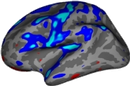
To view the higher-level results, run:
tksurfer fsaverage lh inflated  \
  -overlay xrun/lh.osgm.ffx/osgm/sig.mgh  \
  -fthresh 2 -fmid 3 -fslope 1 -annot aparc.annot
There are several differences between this invocation of tksurfer and the one used during the individual analysis before:
- The subject is fsaverage, not bert
- The input is a sig map, which is -log10(p)
The thresholds are significance thresholds, not z. So, 2 means p < .01.
3.0 Alternative method to resample COPEs to common surface
This command will resample the copes to the common surface space, but does not concatenate them together as mris_preproc does. Rather, it stores the result in fbert1.feat/reg_surf-lh-fsaverage/stats for the left (reg_surf-rh-fsaverage for right).
feat2surf --feat fbert1.feat --cope-only
4.0 Surface-based Group Analysis (Random Effects)
Usually, you will have many subjects and will want to run a random effects analysis. To do this, stack your subjects into one file (lh.cope1.mgh below) using mris_preproc or mri_concat and run the command below:
mri_glmfit --y lh.cope1.mgh \
           --osgm --glmdir lh.osgm.rfx --surf fsaverage lh \
           --label $SUBJECTS_DIR/fsaverage/label/lh.cortex.label
Back to list of all tutorials
Back to course page
FslFeat Tutorial Homepage