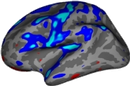
|
Size: 9459
Comment:
|
Size: 9655
Comment:
|
| Deletions are marked like this. | Additions are marked like this. |
| Line 98: | Line 98: |
| Switch back to viewing the inflated surface of the brain by pushing the attachment:icon_surf_main.gif button. | Switch back to viewing the inflated surface of the brain by pushing the attachment:icon_main_surface.gif button. You can now load in the curvature file, lh.curv, by holding ctrl and right clicking on the attachment:icon_curv.gif button. The curvature file will look like this: attachment:curv.jpg |
| Line 101: | Line 103: |
- To follow this exercise exactly be sure you've downloaded the tutorial data set before you begin. If you choose not to download the data set you can follow these instructions on your own data, but you will have to substitute your own specific paths and subject names.
Inspection of Freesurfer Output
In this exercise you will be able to visualize and inspect a good output so that you can become familiar with what the end product should look like. This will step you through visual inspection of a variety of output, but is not necessarily the recommended procedure to take when trying to verify each subject. Some steps are only necessary to check when there are problems, however it is a good idea for new users to become familiar with what the expected output look like and how to view it.
First you need to set your SUBJECTS_DIR to the appropriate place:
setenv SUBJECTS_DIR $FREESURFER_HOME/subjects/buckner_data/tutorial_subjs
Viewing Volumes with Tkmedit
The volumes that are output can be loaded into tkmedit, along with surfaces and the subcortical segmentation. With one command line you can load in the brainmask.mgz and wm.mgz volumes, the rh.white and lh.white surfaces, and the subcortical segmentation.
tkmedit good_output brainmask.mgz lh.white -aux wm.mgz -aux-surface rh.white -segmentation aseg.mgz
You should see a tkmedit window open up to this:BR attachment:good_output1.jpg BR
You are currently looking at the brainmask.mgz (loaded as the main volume) with the surfaces displayed and the aseg.mgz (subcortical segmentation) overlayed. The pial (red line), white (yellow line) and orig (green line) surfaces are all shown. You can toggle between the brainmask.mgz (main volume) and the wm.mgz (aux volume) and you can click on and off the aseg.mgz overlay. To become more familar with the buttons in the Tkmedit Toolbox please read the [wiki:FsTutorial/Tools Freesurfer Tools] section of this tutorial.
Here are the things you can look at while this is loaded in tkmedit:
- intensity normalization
- skull strip
- wm.mgz volume
- the final surfaces
- subcortical segmentation
For the first run through you might find it easiest to toggle off the aseg with the attachment:icon_seg_volume.gif button. Using ctrl-g on the keyboard will have the same effect. You may also find it easier if you toggle off all the surfaces with the attachment:icon_pial_surface.gif, attachment:icon_orig_surface.gif, and attachment:icon_main_surface.gif buttons.
Intensity Normalization
Scroll through the brainmask volume and notice that the intensity is all uniform. You should not see any very bright or very dark spots. If you click on any voxel that is in the wm you can see that it has been normalized to an intensity of (or very close to) 110. The voxel intensity is shown in the Tkmedit Toolbox. This check and the following, Skull Strip check, can be done simultaneously since they both require you to look at features on the brainmask volume.
Skull Strip
Scroll through the brainmask volume and notice that there is no skull left in your image, notice also that the cerebellum is still included in the brainmask volume. You should not see any large areas of skull left behind, or any areas of cortex or cerebellum removed from this volume. This check and the previous, Intensity Normalization check, can be done simultaneously since they both require you to look at features on the brainmask volume.
White Matter Volume
Switch to view the auxillary volume by using the attachment:icon_aux_volume.gif button (ctrl-2 on the keyboard will also do this), this will show the wm.mgz volume. This volume is comprised of all the voxels that freesurfer is calling white-matter, shown in shades of gray. These are the voxels that were normalized to an intensity of, or very close to, 110 as described above. The bright white voxels are voxels that have been added to the volume during the automatic editting of the wm volume. These edits fill the entire ventricle and basal ganglian defect. You can alternate between the wm.mgz volume ( attachment:icon_aux_volume.gif button) and the brainmask.mgz volume (attachment:icon_main_volume.gif button) to see how well freesurfer has classified the white matter.
Final Surfaces
Switch back to the main volume by using the attachment:icon_main_volume.gif button (ctrl-1 on the keyboard will also do this), this will show the brainmask.mgz volume. To check your surfaces you will need to toggle them back on with the attachment:icon_pial_surface.gif for the pial surface, attachment:icon_main_surface.gif for the white surface, and attachment:icon_orig_surface.gif for the orig surface. The surfaces that are overlaid are the pial surface (red line), white surface (yellow line), and orig surface (green line). The orig surface is the "first guess" at the boundary between the white matter and gray matter. After topology fixing and some other steps the white surface is generated. The white surface is the best and final estimation at the boundary between the white matter and gray matter. The white surface is the surface used in all calculations of thickness so it is important that this surface follows the boundary of the white matter accurately. The pial surface is should accurately follow the boundary between the gray matter and the CSF. As you scroll through the slices keep in mind that you are looking at a 2-dimensional rendering of a 3-dimensional image, be sure to look at more than just one view too (i.e., sagittal, coronal and horizontal).
Subcortical Segmentation
Toggle on the subcortical segmentation with the attachment:icon_seg_volume.gif button. This will show the complete segmentation of the subcortical structures. Each structure is labeled with a unique color/number distinction. If you click on a voxel the structures name and number label will be shown in the Tkmedit Toolbox. Scrolling through the slices you will be able to see that everything is labeled, and done so accurately. Sometimes it is easier to see the structures and their boundaries looking in either the sagittal or horizontal view, so be sure to check around in all of them.
Viewing Surfaces with Tksurfer
Now that you've checked out everything in tkmedit you can close it and begin to inspect the surfaces that are output, for this you will use tksurfer. Tksurfer displays one hemisphere at a time, this exercise will go through visualizing things on the left hemisphere only but everything works the same on the right hemisphere (except in the initial command you should specify rh instead of lh if you want to look at the right hemisphere). To become more familar with the buttons in the Tksurfer Toolbox please read the [wiki:FsTutorial/Tools Freesurfer Tools] section of this tutorial.
Here are the things you can look at with tksurfer:
- pial, white and inflated surface
- sulc and curv curvature files
- thickness files
- cortical parcellation
To open tksurfer with the left hemisphere inflated surface of your subject use the following command:
tksurfer good_output lh inflated
You should see a tksurfer window open up to this: BR attachment:tksurfer.jpg
You are currently looking at the inflated surface. The surface can be rotated using the buttons in the navigation toolbar: attachment:icon_arrow_rot_x_pos.gif attachment:icon_arrow_rot_z_neg.gif attachment:icon_arrow_rot_y_neg.gif attachment:icon_arrow_rot_x_neg.gif attachment:icon_arrow_rot_y_pos.gif attachment:icon_arrow_rot_z_pos.gif
Inflated surface
The inflated surface is good to look at when checking to see if you need to make edits to the wm.mgz volume. You'll notice as you inspect this surface that it is smooth and free from holes, bumps and other defects.
Pial Surface
You can load in other surfaces, and tksurfer will then allow you to switch between them all. The easiest way to do this is to hold down CONTROL and click with the right mouse button on the various surface buttons. To load the Pial Surface hold ctrl and right click the pial surface button attachment:icon_pial_surface.gif a box will pop up where you could browse to the location of the surface you want to load, but it should be already filled in with the path to the lh.pial surface - so you can hit ok. This is what the pial surface will look like:
attachment:pial.jpg
The pial surface is showing you the outer boundary of the gray matter/CSF. This is the same file that was viewed in tkmedit, just represented as a surface image rather than an outline on the volume. You can inspect this surface by rotating it around as you wish.
White Surface
You can follow the same procedure that you used to load the pial surface for the white surface, except this time hold ctrl and right click the white surface button attachment:icon_white_surface.gif You can inspect this surface by rotating it around as you wish. This is what the white surface will look like:
attachment:white.jpg
The white surface shows the boundary between the white and the gray matter. Again, this is the same file that was viewed in tkmedit just represented differently.
Curv Surface
Switch back to viewing the inflated surface of the brain by pushing the attachment:icon_main_surface.gif button. You can now load in the curvature file, lh.curv, by holding ctrl and right clicking on the attachment:icon_curv.gif button. The curvature file will look like this:
attachment:curv.jpg