|
Size: 9227
Comment:
|
Size: 8688
Comment:
|
| Deletions are marked like this. | Additions are marked like this. |
| Line 83: | Line 83: |
| There is a version of the code that estimates the registration with [[https://direct.mit.edu/imag/article/doi/10.1162/imag_a_00197/121549/Anatomy-aware-and-acquisition-agnostic-joint|SynthMorph (Hoffmann et al., Imaging Neuroscience, 2024)]], rather than FireANTs. This version is very good for 1mm isotropic in vivo scans. However, SynthMorph relies heavily on fitting the boundaries of whole structures and does not the map smaller regions (e.g., thalamic nuclei) as well as the FireANTs version. Therefore, we do not recommend it for images with resolution better than 1mm isotropic. Also, it does not support ex vivo scans, cerebra, or single hemispheres. the command is: {{{ mri_histo_atlas_segment_synthmorph INPUT_SCAN OUTPUT_DIRECTORY GPU THREADS }}} The input arguments and structure of the output directory are very similar to those of mri_histo_atlas_segment_fireants. <<BR>> |
The code also accepts the following optional flags: |
| Line 92: | Line 85: |
| === 5. Legacy mode === | * --bf_mode: Decides the bias field basis function model. Options: dct (default), polynomial, hybrid. * --write_rgb: Save an RGB image based on the posterior probabilites to disk. * --write_bias_corrected: Save the bias corrected input image to disk. * --device_registration: Define a different device for the registration. Can be used to save GPU memory when working with an GPU with limited memory. Options: cpu, cuda. Default is the same as --device. * --threads: Control the number of cpu thread used to run the algorithm. Default value is -1, which uses all available threads. * --skip: An integer skipping (downsampling) factor for estimating the model parameters. More skipping saves memory, but sacrifices accuracy. Default: 1 (no skipping). * --resolution: The resolution of the output segmentation. By default 0.4mm, which is higher than the typical input scan, to reduce aliasing. * --smoothing_steps_HRmask: Number of smoothing steps used when upsampling the 1mm brain mask from BrainFM. More smoothing makes the outer border less jagged, but too much smoothing reduces accuracy. Default: 3. * --skip_bf: Skip the bias field correction. Can be used to save memory if the input scan is already bias corrected or does not have a bias field (non MRI modality). * --smooth_grad_sigma: Gradient field smoothing parameter for the nonlinear FireAnts registration. Default: 1.0. * --smooth_warp_sigma: Warp field smoothing parameter for the nonlinear FireAnts registration. Default: 0.25. * --optimizer_lr: Learning rate for the nonlinear FireAnts registration optimizer. Default: 0.5. * --cc_kernel_size: Size of the window for calculating the cross-correlation registration metric. Default: 7. * --rel_weight_labeldiff: Relative weight for the Dice loss metric in the nonlinear registration. Default: 2.5. * --save_atlas_nonlinear_reg: Save the nonlinearly registered atlas. Default: false. * --save_field: Save the nonlinear deformation field. Default: false. * --save_jacobian: Save the Jacobian determinant (log10) of the deformation field. Default: false. |
| Line 94: | Line 103: |
| We discourage users from using this version, which we only keep for compatibility and reproducibility. | Some notes: |
| Line 96: | Line 105: |
| Our original implementation (still available for compatibility and reproducibilityw) used a "proper" Bayesian inference algorithm that makes segmentation incredibly slow (tens of hours) unless a GPU with pretty large RAM is available. |
* If you are running out of memory, using --skip 2 can help without sacrificing much accuracy. * The defaults --smooth_grad_sigma 1 and --smooth_warp_sigma 0.25 are pretty liberal and can cope with massive deformation, e.g., as in the Hip-CT images shown in the paper "Fast segmentation with the NextBrain". If you are working with a population without very strong atrophy or deformation, you can multiply those values by 2 in order to get more regular atlas deformation fields (you can explore the deformation with the --save_jacobian option). Also: you can flexibly change the groupings of the modeled structures using the .yaml files under the /data_simplified folder. The structure groupings for the Gaussian Mixture modeled are controlled by two files: gmm_components_fireants.yaml and combined_atlas_labels_fireants.yaml. Let's say, as an example, that you wanted to add the internal segment of globus pallidus (label 206) as its own structure. To model it separately, you would first create a new class, called e.g., Internal Segment Pallidum, in the combined_atlas_labels_fireants.yaml file, and list label 206 under that structure (while removing it from the pallidum class). Next, you would add the class, with exactly the same name, to the gmm_components_fireants.yaml file and decide how many Gaussian distributions should be used to model its intensities. To make the non-linear registration aware of the contrast, you would add the structure, again with exactly the same name, to the file called recipe_intensities_cheating_image_fireants.yaml, and decide how its intensity should be generated from the seven structures than can be always reliably segmentation using BrainFM (see the file for examples). |
| Line 101: | Line 111: |
| To segment a brain MRI scan, {{{ mri_histo_atlas_segment_fullbayesian INPUT_SCAN OUTPUT_DIRECTORY ATLAS_MODE GPU THREADS [BF_MODE] [GMM_MODE] }}} where: ''INPUT_SCAN'': scan to process, in mgz or nii(.gz) format. ''OUTPUT_DIRECTORY'': directory where segmentations, volume files, etc, will be created (more on this below). ''ATLAS_MODE'' : full (atlas with all 333 labels) or simplified (simpler brainstem protocol used by fast versions; recommended) ''GPU'': set to 1 to use the GPU ('''we highly recommend using a GPU to run this module; without a GPU, running this module on a single scan can take tens of hours'''). The GPU requirements depend on the image but are about 24GB of memory. ''THREADS'': number of CPU threads used by the code (set to -1 to use all available threads). ''BF_MODE'' (optional): bias field mode: dct (default), polynomial, or hybrid. ''GMM_MODE'' (optional): gaussian mixture model (GMM) mode: must be 1mm unless you define your own (see FAQ below). In the output directory, you will find: ''bf_corrected.mgz'': a bias field corrected version of the input scan. ''SynthSeg.mgz'': [[https://surfer.nmr.mgh.harvard.edu/fswiki/SynthSeg|SynthSeg]] segmentation of the input (which we use in preprocessing and to initialize Gaussian parameters). ''MNI_registration.mgz'': [[https://surfer.nmr.mgh.harvard.edu/fswiki/EasyReg|EasyReg]] registration to MNI space, use in preprocessing. ''seg_[left/right].mgz'': segmentation into 333 ROIs of the left and right hemisphere, respectively. ''vols_[left/right].csv'': CSV spreadsheet with the volumes of the different ROIs, computed from the posteriors (soft segmentations). ''lookup_table.txt'': FreeSurfer lookup table mapping label indices to brain anatomy. You need it when visualizing the segmentations with Freeview. <<BR>> <<BR>> |
<BR> |
| Line 152: | Line 125: |
| Certainly no! The code should run in less than half an hour on any semi-modern workstation, if you allocate enough threads (or about two hours for an ex vivo scan at 0.25mm resolution). | Certainly not! The code should run in less than half an hour on any semi-modern workstation, if you allocate enough threads (or about two hours for an ex vivo scan at 0.25mm resolution). |
| Line 154: | Line 127: |
| * '''Do I really need a GPU for the 'full' Bayesian version?''' | * '''What happened to the "full Bayesian" and "SynthMorph" versions?''' |
| Line 156: | Line 129: |
| Technically, no. In practice, yes. On a modern GPU, the code runs in an hour or less. On the CPU, it depends on the number of threads, but it can easily take a whole day or more. | To simplify the codebase, we are focusing on this method, which is fast but also versatile in terms of modeling / registration (as opposed to SynthMorph). |
| Line 158: | Line 131: |
| * '''What do the BF_MODE and GMM_MODE arguments do in the full Bayesian version?''' | <<BR>> <<BR>> |
| Line 160: | Line 134: |
| You should not need to touch these, but the BF_MODE changes the set of basis functions for bias field correction and you could potentially try tinkering with it if the bias field correction fails (i.e., if bf_corrected.mgz has noticeable bias). GMM_MODE allows you to change the grouping of ROIs into tissue classes (advanced mode!). The GMM model is crucial as it determines how different brain regions are grouped into tissue types for the purpose of image intensity modeling. This is specified though a set of files that should be found under 'data' in the atlas directory: |
|
| Line 164: | Line 135: |
| ''data/gmm_components_[GMM_MODE].yaml'': defines tissue classes and specificies the number of components of the corresponding GMM ''data/combined_aseg_labels_[GMM_MODE].yaml'' defines the labels that belong to each tissue class ''data/combined_atlas_labels_[GMM_MODE].yaml'' defines FreeSurfer ('aseg') labels that are used to initialize the parameters of each class. We distribute a GMM_MODE named "1mm" that we have used in our experiments, and which is the default mode of the code. If you want to use your own model, you will need to create another triplet of files of your own (use the 1mm version as template). |
Bayesian Segmentation with Histological Atlas "NextBrain"
Visit the homepage of the NextBrain project for further information on this atlas.
Important: please download the latest development version of FreeSurfer to use this package
Author: Juan Eugenio Iglesias
E-mail: jiglesiasgonzalez [at] mgh.harvard.edu
Rather than directly contacting the author, please post your questions on this module to the FreeSurfer mailing list at freesurfer [at] nmr.mgh.harvard.edu
Relevant publications:
"A probabilistic histological atlas of the human brain for MRI segmentation", Casamitjana et al., Nature, 2025. Paper on nature.com.
"Fast segmentation with the NextBrain histological atlas", Puonti et al., under review. Preprint available here.
Contents
- General Description
- Installation
- Basic usage
- Outputs
- Advanced options
- Frequently asked questions (FAQ)
1. General Description
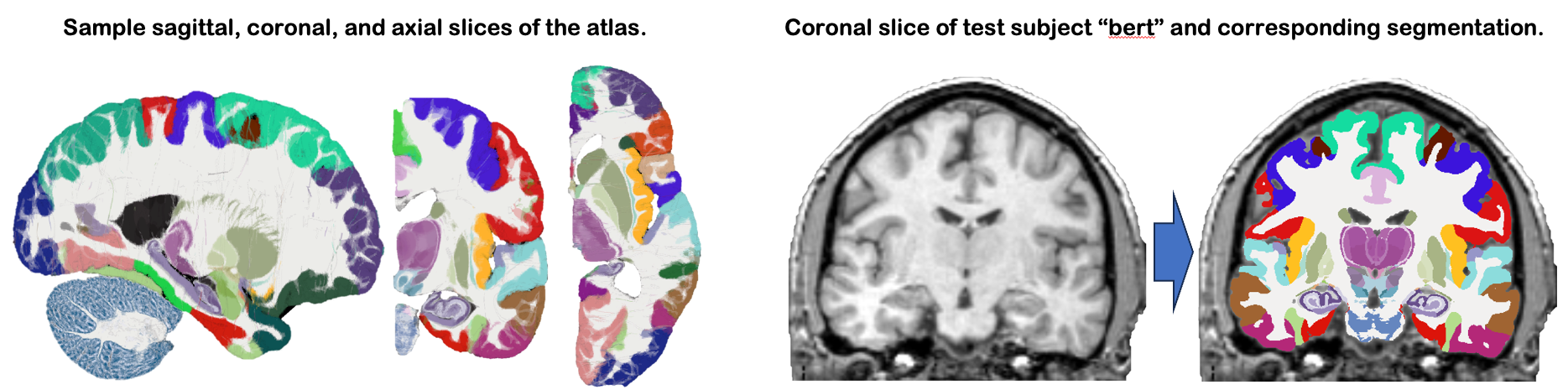
This module uses NextBrain, our new probabilistic atlas of the human brain, to segment ~300 distinct ROIs per hemisphere on in vivo or ex vivo scans (including single hemispheres). Segmentation relies on a Bayesian algorithm and is thus robust against changes in MRI pulse sequence (e.g., T1-weighted, T2-weighted, FLAIR, etc). Sample slices of the atlas and the segmentation of the sample subject "bert" are shown below:
2. Installation
The first time you run this module, it will prompt you to download the atlas. Follow the instructions on the screen to obtain the atlas files.
In addition: this module calls mri_super_synth; if you have never used this command before, it will also prompt you to download a model file.
3. Basic usage
The entry point of the module is the command mri_histo_atlas_segment_fireants, which implements the fast version of the algorithm. This version relies on FireANTs (Jena et al) for fast nonlinear registration of the atlas. The command line is:
mri_histo_atlas_segment_fireants --i INPUT_SCAN --o OUTPUT_DIRECTORY --device [cpu/cuda] --side [left/right] --mode [invivo/cerebrum/hemi/exvivo]
INPUT_SCAN: scan to process, in mgz or nii(.gz) format.
OUTPUT_DIRECTORY: directory where segmentations, volume files, etc, will be created (more on this below).
DEVICE: set to cpu or cuda.
SIDE: left or right. If you're analyzing both sides, you're better off running them sequentially (rather than in parallel) since the SuperSynth preprocessing will be reused when processing the second hemisphere.
MODE: type of scan: invivo, exvivo, cerebrum (ex vivo without brainstem or cerebellum), hemi (ex vivo with single cerebral hemisphere).
4. Outputs
The output directory will contain the following files:
seg.[left/right].nii.gz: segmentation of left/right hemisphere
lut.txt: the lookup table to visualize seg.[left/right].nii.gz, for convenience
vols.[left/right].csv: files with volumes of the brain regions segmented by the atlas, in CSV format.
SuperSynth: directory with segmentation of the scan at the whole structure level.
Additional flags: if advanced options are used (more details below).
5. Advanced options
The code also accepts the following optional flags:
* --bf_mode: Decides the bias field basis function model. Options: dct (default), polynomial, hybrid. * --write_rgb: Save an RGB image based on the posterior probabilites to disk. * --write_bias_corrected: Save the bias corrected input image to disk. * --device_registration: Define a different device for the registration. Can be used to save GPU memory when working with an GPU with limited memory. Options: cpu, cuda. Default is the same as --device. * --threads: Control the number of cpu thread used to run the algorithm. Default value is -1, which uses all available threads. * --skip: An integer skipping (downsampling) factor for estimating the model parameters. More skipping saves memory, but sacrifices accuracy. Default: 1 (no skipping). * --resolution: The resolution of the output segmentation. By default 0.4mm, which is higher than the typical input scan, to reduce aliasing. * --smoothing_steps_HRmask: Number of smoothing steps used when upsampling the 1mm brain mask from BrainFM. More smoothing makes the outer border less jagged, but too much smoothing reduces accuracy. Default: 3. * --skip_bf: Skip the bias field correction. Can be used to save memory if the input scan is already bias corrected or does not have a bias field (non MRI modality). * --smooth_grad_sigma: Gradient field smoothing parameter for the nonlinear FireAnts registration. Default: 1.0. * --smooth_warp_sigma: Warp field smoothing parameter for the nonlinear FireAnts registration. Default: 0.25. * --optimizer_lr: Learning rate for the nonlinear FireAnts registration optimizer. Default: 0.5. * --cc_kernel_size: Size of the window for calculating the cross-correlation registration metric. Default: 7. * --rel_weight_labeldiff: Relative weight for the Dice loss metric in the nonlinear registration. Default: 2.5. * --save_atlas_nonlinear_reg: Save the nonlinearly registered atlas. Default: false. * --save_field: Save the nonlinear deformation field. Default: false. * --save_jacobian: Save the Jacobian determinant (log10) of the deformation field. Default: false.
Some notes:
* If you are running out of memory, using --skip 2 can help without sacrificing much accuracy. * The defaults --smooth_grad_sigma 1 and --smooth_warp_sigma 0.25 are pretty liberal and can cope with massive deformation, e.g., as in the Hip-CT images shown in the paper "Fast segmentation with the NextBrain". If you are working with a population without very strong atrophy or deformation, you can multiply those values by 2 in order to get more regular atlas deformation fields (you can explore the deformation with the --save_jacobian option).
Also: you can flexibly change the groupings of the modeled structures using the .yaml files under the /data_simplified folder. The structure groupings for the Gaussian Mixture modeled are controlled by two files: gmm_components_fireants.yaml and combined_atlas_labels_fireants.yaml. Let's say, as an example, that you wanted to add the internal segment of globus pallidus (label 206) as its own structure. To model it separately, you would first create a new class, called e.g., Internal Segment Pallidum, in the combined_atlas_labels_fireants.yaml file, and list label 206 under that structure (while removing it from the pallidum class). Next, you would add the class, with exactly the same name, to the gmm_components_fireants.yaml file and decide how many Gaussian distributions should be used to model its intensities. To make the non-linear registration aware of the contrast, you would add the structure, again with exactly the same name, to the file called recipe_intensities_cheating_image_fireants.yaml, and decide how its intensity should be generated from the seven structures than can be always reliably segmentation using BrainFM (see the file for examples).
<BR>
6. Frequently asked questions (FAQ)
I have an ex vivo hemisphere with cerebellum and/or brainstem
If you use the hemi mode, you will not get the cerebellum or brainstem. Use the exvivo mode instead (with the caveat that you may lose some voxels around the medial wall, which may get assigned to the contralateral hemisphere).
Can the exvivo model handle arbitrary orientations of the input
No, it cannot. You need to manually reorient the brain to RAS (e.g., with Freeview).
Do I need a GPU?
Certainly not! The code should run in less than half an hour on any semi-modern workstation, if you allocate enough threads (or about two hours for an ex vivo scan at 0.25mm resolution).
What happened to the "full Bayesian" and "SynthMorph" versions?
To simplify the codebase, we are focusing on this method, which is fast but also versatile in terms of modeling / registration (as opposed to SynthMorph).