|
Size: 3976
Comment:
|
← Revision 64 as of 2019-08-09 15:18:12 ⇥
Size: 4591
Comment:
|
| Deletions are marked like this. | Additions are marked like this. |
| Line 1: | Line 1: |
| ## page was renamed from ProjectNameOrWhatever | |
| Line 7: | Line 6: |
<<TableOfContents(5)>> |
|
| Line 14: | Line 15: |
| Usage: ./bundleAnalysis.sh <Patient File> <OPTION: DTI> | Usage: {{{ ./bundleAnalysis.sh <Patient File> <OPTION: DTI> }}} |
| Line 22: | Line 25: |
| === Individually === | == Individually Programs == |
| Line 24: | Line 27: |
| ==== Group by Endpoints ==== | === Group by Endpoints === |
| Line 26: | Line 29: |
| Usage: ./dmri_groupByEndpoints -s <streamlineFile> -i <imageFile> -d <outputDirectory> | Usage: {{{ ./dmri_groupByEndpoints -s <streamlineFile> -i <imageFile> -d <outputDirectory> }}} |
| Line 28: | Line 33: |
| The program will take in a streamline file and an image file, cluster the streamlines, and output TRK files to the output directory | The program will take in a streamline file and an image file, cluster the streamlines based on location, and output TRK files to the output directory |
| Line 30: | Line 35: |
| ===== Output ===== | ==== Output ==== |
| Line 32: | Line 37: |
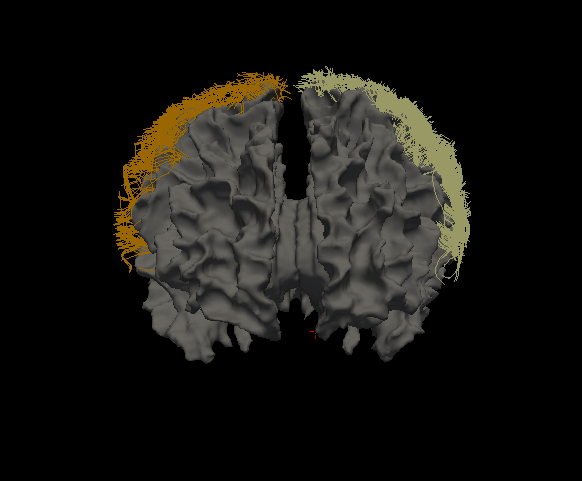
| The output directory will be filled with TRK files. Each TRK file will be labeled with the name of the region and each will be filled with streamlines that connect the region. See below: | The output directory will be filled with TRK files. Each TRK file will be labeled with the name of the region and each will be filled with streamlines that begin and end within it. See below: |
| Line 34: | Line 39: |
| {{attachment:Clustered Streamlines.png||width="500",height="350"}} {{attachment:Clustered Streamlines 2.png||width="500",height="350"}} | |
| Line 35: | Line 41: |
| === Extract Surface Measurements === | |
| Line 36: | Line 43: |
| ==== Extract Surface Measurements ==== Usage: ./dmri_extractSurfaceMeasurements -i <streamlineFile(s)> -sl <Left Hemisphere Surface> -tl <Left Thickness File> -cl <Left Curvature File> -sr <Right Hemisphere Surface> -tr <Right Thickness File> -cl <Right Curvature File> -o <outputDirectory> |
Usage: {{{ ./dmri_extractSurfaceMeasurements -i <streamlineFile(s)> -sl <Left Hemisphere Surface> -tl <Left Thickness File> -cl <Left Curvature File> -sr <Right Hemisphere Surface> -tr <Right Thickness File> -cl <Right Curvature File> -o <outputDirectory> |
| Line 41: | Line 47: |
| }}} | |
| Line 44: | Line 51: |
| ===== Output ===== | ==== Output ==== |
| Line 48: | Line 55: |
| '''WITH -FA FLAG''' | '''With -FA Flag''' |
| Line 50: | Line 57: |
| {{attachment:CSV.png||width="950",height="400"}} | |
| Line 51: | Line 59: |
| '''Without Flag''' | |
| Line 52: | Line 61: |
| '''WITHOUT FLAG''' | {{attachment:CSV_noFA.png||width="500",height="400"}} |
| Line 54: | Line 63: |
| == Additional Programs == | |
| Line 55: | Line 65: |
| === Change Endpoints === | |
| Line 56: | Line 67: |
| === Additional Programs === ==== Change Endpoints ==== Usage: ./dmri_changeEndpoints -i <streamlineFile> -sl <Left Hemisphere Surface> -sr <Right Hemisphere Surface> -ol <Left Overlay Filename> -or <Right Overlay Filename> -itk <Itk Volume File> -fs <FS Volume File> |
Usage: {{{ ./dmri_changeEndpoints -i <streamlineFile> -sl <Left Hemisphere Surface> -sr <Right Hemisphere Surface> -ol <Left Overlay Filename> -or <Right Overlay Filename> -itk <Itk Volume File> -fs <FS Volume File> }}} |
| Line 64: | Line 73: |
| ===== Output ===== | ==== Output ==== |
| Line 68: | Line 77: |
| ==== Plots ==== | {{attachment:Endpoints.png||width="650",height="350"}} {{attachment:Endpoints 2.png||width="550",height="350"}} |
| Line 70: | Line 79: |
| Usage: python3 ./dmri_plots.py <inputDirectory> <Grouping CSV> <Structure Name> | === Plots === |
| Line 72: | Line 81: |
| The program will take in an input Directory (containing subject directories), a CSV files that divides the subjects into groups, and the name of a structure. For every subject, multiple violin plots are created to organize the data from every column of the structure's CSV file. The plot will be further explained below. | Usage: {{{ python3 ./dmri_plots.py <inputDirectory> <Grouping CSV> <Structure Name> }}} |
| Line 74: | Line 85: |
| ===== Output ===== | The program will take in an input directory containing the subjects as subdirectories, a CSV file that divides the subjects into groups, and the name of a structure. For every subject, multiple violin plots are created to organize the data from every column of the structure's CSV file. The plot will be further explained below. |
| Line 76: | Line 87: |
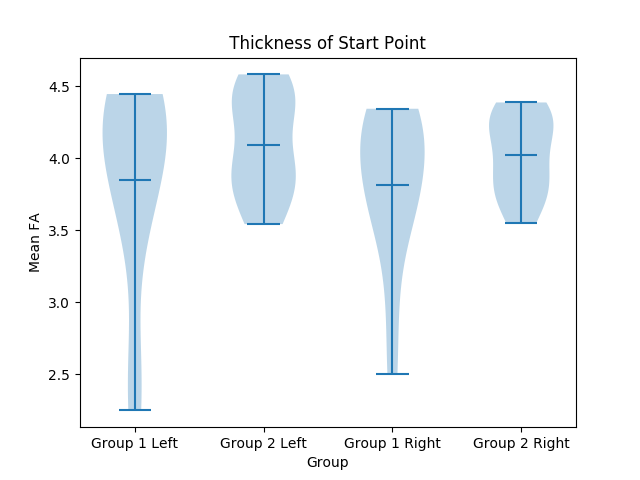
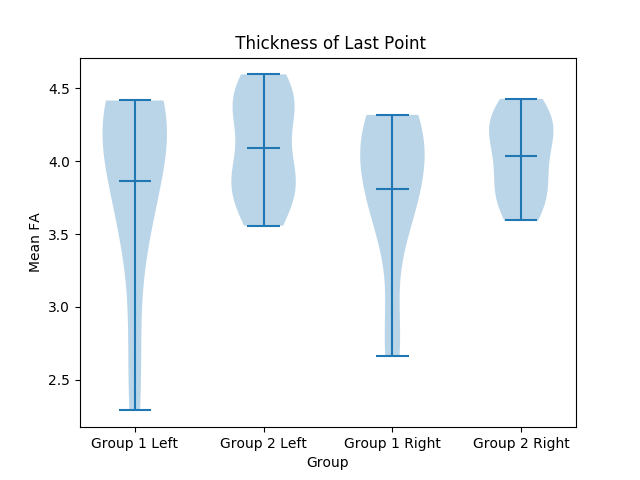
| The output will be 12 violin plots that will open on your desktop, each one containing 4 violins. On the left half, these two violins represent the left and right hemisphere of group 1, while the other two represent the left and right hemisphere of group 2. See below: | ==== Output ==== The output will be a number of violin plots based on the amount of value types. In the data, each group is represented by 2 violin plots, one for both the left and right halves. For example, on the left half, these two violins represent the left and right hemisphere of group 1, while the other two represent the left and right hemisphere of group 2. See below: {{attachment:Violin Plot 1.png||width="650",height="300"}} {{attachment:Violin Plot 2.png||width="650",height="300"}} |
U-Shape Bundle Analysis
Note: all of the source code can be found on the "dmri" branch on the Freesurfer Github page. The link can be found here:
https://github.com/freesurfer/freesurfer/tree/dmri/anatomicuts
Contents
How to Run
Note by running the executable with no parameters will also give information on how to run the program
Main Bundle Analysis Program
Usage:
./bundleAnalysis.sh <Patient File> <OPTION: DTI>
DTI is an option that allows more metrics about the FA values to be outputted based on 4 volumes
This program runs both dmri_groupByEndpoints and dmri_extractSurfaceMeasurements and the outputs will be under its respective section below
If specific files are wanted to be used or files cannot be found, run the programs individually (read below)
Individually Programs
Group by Endpoints
Usage:
./dmri_groupByEndpoints -s <streamlineFile> -i <imageFile> -d <outputDirectory>
The program will take in a streamline file and an image file, cluster the streamlines based on location, and output TRK files to the output directory
Output
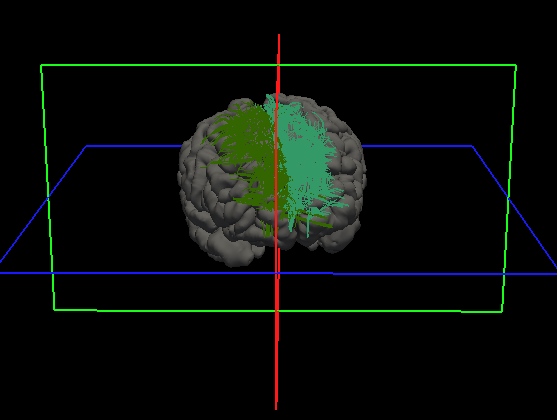
The output directory will be filled with TRK files. Each TRK file will be labeled with the name of the region and each will be filled with streamlines that begin and end within it. See below:
Extract Surface Measurements
Usage:
./dmri_extractSurfaceMeasurements -i <streamlineFile(s)> -sl <Left Hemisphere Surface> -tl <Left Thickness File> -cl <Left Curvature File> -sr <Right Hemisphere Surface> -tr <Right Thickness File> -cl <Right Curvature File> -o <outputDirectory>

OPTIONAL FLAG: -fa <number of Measures> <Given Name 1> <File 1> ... <Given Name X> <File X>
The program will take in streamlines, a full brain surface with overlay files, an output directory, and possibly image files, and will output surface metrics, such as thickness and curvature as well as FA at the endpoints of the streamlines
Output
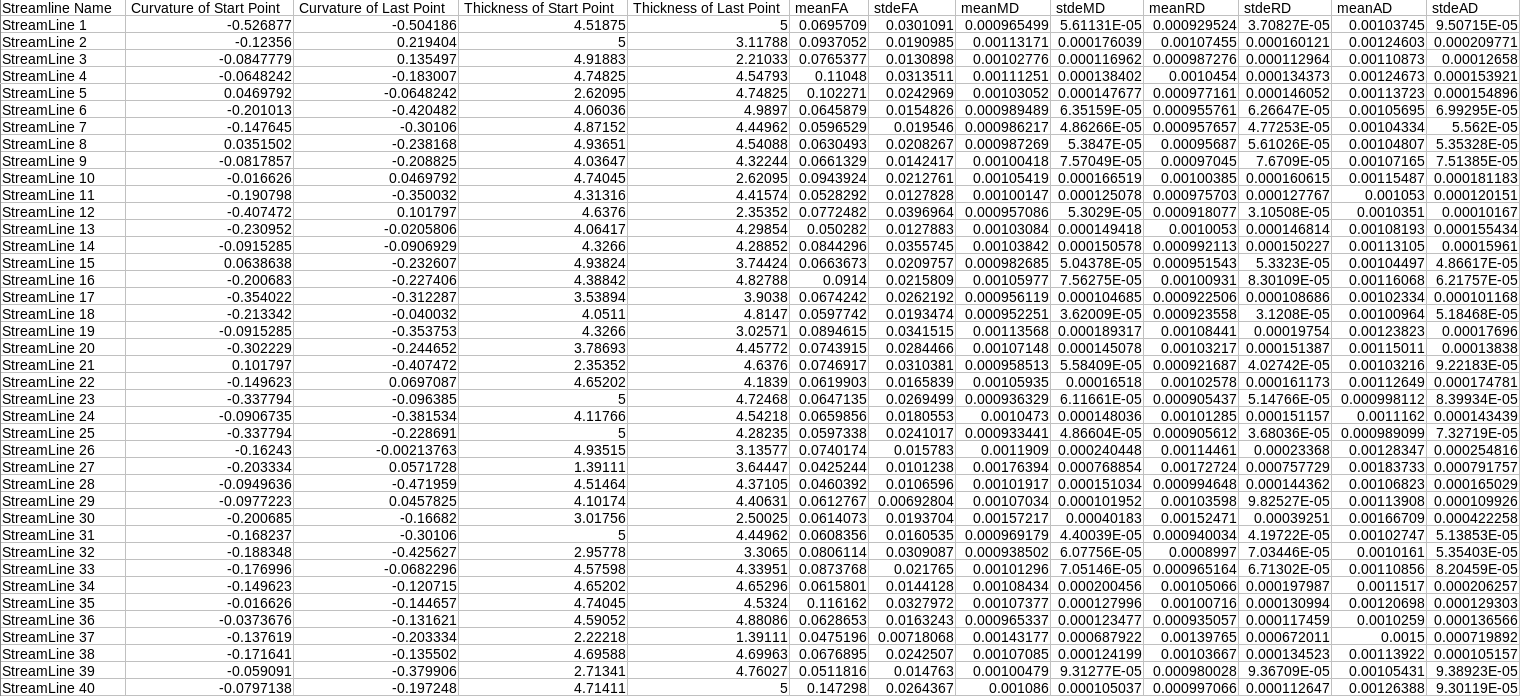
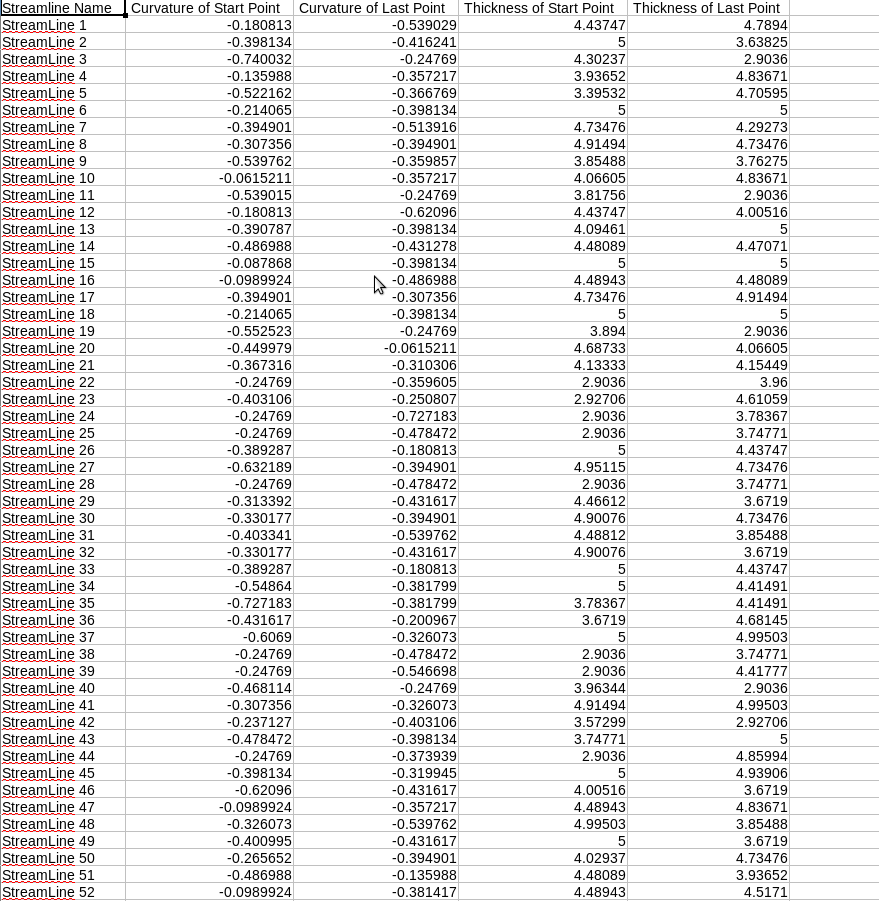
The output directory will be filled with CSV files. Each CSV file will be labeled with the name of the region and each will contain numerous metrics, such as thickness and curvature. If the -fa flag is used, an addition 2 or more column will contain the mean FA and standard deviation. See below:
With -FA Flag
Without Flag
Additional Programs
Change Endpoints
Usage:
./dmri_changeEndpoints -i <streamlineFile> -sl <Left Hemisphere Surface> -sr <Right Hemisphere Surface> -ol <Left Overlay Filename> -or <Right Overlay Filename> -itk <Itk Volume File> -fs <FS Volume File>
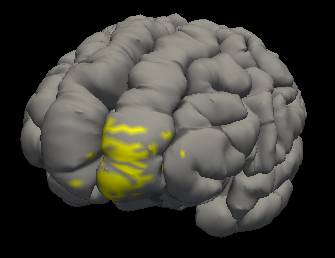
The program will take in two volumes, a streamline, a surface, and the names of the overlay file that will be created. It will assign the endpoints of the streamline to a set number (usually a value of 1, but can be changed by adjusting the value of the variable at the top)
Output
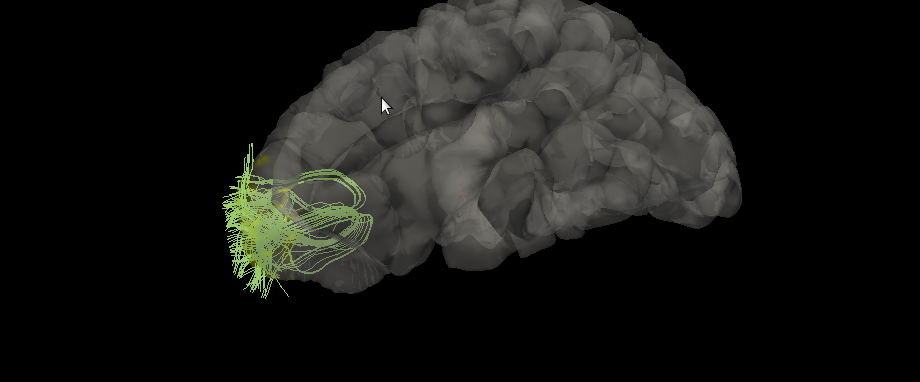
The new overlay files will be created in the same directory with the name that it was passed with. The overlay files will be completely blank (values are zero) besides the points near the beginning and end of the streamline passed in, which will have a value that was set before it was run. See below:
Plots
Usage:
python3 ./dmri_plots.py <inputDirectory> <Grouping CSV> <Structure Name>
The program will take in an input directory containing the subjects as subdirectories, a CSV file that divides the subjects into groups, and the name of a structure. For every subject, multiple violin plots are created to organize the data from every column of the structure's CSV file. The plot will be further explained below.
Output
The output will be a number of violin plots based on the amount of value types. In the data, each group is represented by 2 violin plots, one for both the left and right halves. For example, on the left half, these two violins represent the left and right hemisphere of group 1, while the other two represent the left and right hemisphere of group 2. See below: