|
Size: 18889
Comment:
|
← Revision 97 as of 2013-11-01 14:32:41 ⇥
Size: 20867
Comment:
|
| Deletions are marked like this. | Additions are marked like this. |
| Line 1: | Line 1: |
| ## page was renamed from FsTutorial/AnatomicalROI | |
| Line 3: | Line 4: |
| = Anatomical ROI analysis = This tutorial gives a brief introduction to anatomical ROI analysis which includes working with label files, extracting ROI measures from the anatomical data, group statistics etc. |
|
| Line 5: | Line 10: |
| = Anatomical ROI analysis = This tutorial gives a brief introduction to anatomical ROI analysis which includes working with label files, extracting ROI measures from the anatomical data, group statistics etc. Make sure you have set your SUBJECTS_DIR to correct location as ---- {{{ setenv TUTORIAL_DATA $FREESURFER_HOME/subjects/buckner_data/tutorial_subjs setenv SUBJECTS_DIR $TUTORIAL_DATA/group_analysis_tutorial |
== Preparations == === If You're at an Organized Course === If you are taking one of the formally organized courses, everything has been set up for you on the provided laptop. The only thing you will need to do is run the following commands in ''every'' '''new''' terminal window (aka shell) you open throughout this tutorial. Copy and paste the commands below to get started: {{{ setenv SUBJECTS_DIR $TUTORIAL_DATA/buckner_data/tutorial_subjs/group_analysis_tutorial |
| Line 15: | Line 18: |
| ---- |
''To copy: Highlight the command in the box above, right click and select copy (or use keyboard shortcut Ctrl+c), then use the middle button of your mouse to click inside the terminal window (this will paste the command). Press enter to run the command.'' These two commands set the SUBJECTS_DIR variable to the directory where the data is stored and then navigates into this directory. You can now skip ahead to the tutorial (below the gray line). === If You're not at an Organized Course === If you are '''NOT''' taking one of the formally organized courses, then to follow this exercise exactly be sure you've downloaded the [[FsTutorial/Data|tutorial data set]] before you begin. If you choose not to download the data set you can follow these instructions on your own data, but you will have to substitute your own specific paths and subject names. These are the commands that you need to run before getting started: {{{ tcsh source your_freesurfer_dir/SetUpFreeSurfer.csh setenv SUBJECTS_DIR $TUTORIAL_DATA/buckner_data/tutorial_subjs/group_analysis_tutorial cd $SUBJECTS_DIR }}} Notice the command to open tcsh. If you are already running the tcsh command shell, then the 'tcsh' command is not necessary. If you are not using the tutorial data you should set your {{{SUBJECTS_DIR}}} to the directory in which the recon(s) of the subject(s) you will use for this tutorial are located. -------- |
| Line 21: | Line 38: |
| Open the subject in tkmedit using the following command | Open the subject in tkmedit using the following command: |
| Line 31: | Line 48: |
| setenv SUBJECTS_DIR $TUTORIAL_DATA/buckner_data/tutorial_subjs/group_analysis_tutorial cd $SUBJECTS_DIR |
|
| Line 34: | Line 53: |
| Finally, run the following command to display the contents of LUT | Finally, run the following command to display the contents of LUT (in ''another'' new terminal window) |
| Line 40: | Line 59: |
| You can hit the 'Page Up' and 'Page Down' buttons to see the rest of the file. Or click [[FsTutorial/AnatomicalROI/FreeSurferColorLUT|here]] to view the contents of the file. | You can hit the 'Page Up' and 'Page Down' buttons to see the rest of the file. Or click [[FsTutorial/AnatomicalROI/FreeSurferColorLUT|here]] to view the contents of the file. (To exit the less command, hit the 'q' button.) |
| Line 53: | Line 72: |
| 1. In tkmedit, click on Goto Point button {{attachment:icon_cursor_goto.gif}}. | 1. In tkmedit, click on Goto Point button {{attachment:icon_cursor_goto.gif}} , which takes the cursor to the ROI. Zoom in to see the cursor. |
| Line 58: | Line 77: |
| You can close tkmedit and tksurfer once you are done. To get out of the less command, type 'q' for quit. |
|
| Line 62: | Line 83: |
| To map a label, such a lh.BA45.label, from an average subject to a target subject, run | To map a label, such as the lh.BA45.label, from the fsaverage subject to a target subject, run |
| Line 74: | Line 95: |
| And then to look at that label file, run | Although we used an existing label for the example above, you could draw a new label on fsaverage and map that to all your subjects so that it will appear in the same cortical region. To take a look at the contents of that newly created label file, run: |
| Line 80: | Line 101: |
| To load a label in tkmedit, first load the subject you want to work on, in tkmedit. | To load the label in tkmedit, first load the subject you want to work on, in tkmedit. |
| Line 86: | Line 107: |
| Then on the menu bar at the top of tkmedit tools window, go to '''File --> Label --> Load Label --> Browse --> lh.BA45.label''' and hit 'OK' in both windows. {{attachment:label.jpg}} |
Then on the menu bar at the top of tkmedit tools window, go to '''File --> Label --> Load Label --> Browse --> lh.BA45.label''' and hit 'OK' in both windows. The label is visible in coronal slice 153. {{attachment:BAlabel.jpg}} |
| Line 92: | Line 113: |
| To load the label in tksurfer, first load the subject. | To load the label in tksurfer, first load the subject (in another terminal window). |
| Line 100: | Line 121: |
| {{attachment:tksurferlabel.jpg}} Information on how to create and edit labels in tksurfer can be found on [[https://surfer.nmr.mgh.harvard.edu/fswiki/tksurfer_labeledit|this wiki]]. |
{{attachment:BAlabel_tksurfer.jpg}} Information on how to create and edit labels in tksurfer can be found on [[https://surfer.nmr.mgh.harvard.edu/fswiki/tksurfer_labeledit|this wiki]]. You don't have to do this for the tutorial, but please feel free to take a look if you are interested. |
| Line 106: | Line 127: |
| During the normal FreeSurfer processing stream, via the recon-all script, [[http://surfer.nmr.mgh.harvard.edu/fswiki/FsTutorial|(a freesurfer tutorial is available.)]] some statistical output files are generated. They are kept in each subjects' {{{stats/}}} subdirectory and are generated for the subcortical segmentation (aseg) and the cortical parcellation (aparc). These tables include information on each labeled region for the individual subject. | During the normal FreeSurfer processing stream, via the recon-all script some statistical output files are generated. They are kept in each subjects' {{{stats/}}} subdirectory and are generated for the subcortical segmentation (aseg) and the cortical parcellation (aparc). These tables include information on each labeled region for the individual subject. |
| Line 119: | Line 140: |
| At the head of the text file there will be information about the command that was run, the version used, the user who ran it and a time stamp. Following this there is information about the volume of the entire brain. This shows the number of voxels in the brainmask {{{(BrainMaskNVox)}}}, the volume of the brainmask {{{(BrainMaskVol)}}}, the number of voxels in the brainseg {{{(BrainSegNVox)}}}, the volume of the brainseg {{{(BrainSegVol)}}}, and the intracranial volume {{{(ICV)}}}. This part of the file also tells us that the brainmask.mgz volume is being used as !BrainMask {{{(BrainMaskFile mri/brainmask.mgz)}}} and the aseg.mgz segmentation is being used as the !SegVol {{{(SegVolFile mri/aseg.mgz)}}}. The number of voxels and the volumes should be the same for this subject, since this part of the file also tells us that the voxel volume is 1 mm^3^ {{{(VoxelVolume_mm3 1)}}} - and volume is measured in mm^3^. <<BR>> | At the head of the text file there will be information about the command that was run, the version used, the user who ran it and a time stamp. Following this there is information about the volume of the entire brain. <<BR>> |
| Line 127: | Line 148: |
| # Title Segmentation Statistics # |
# Title Segmentation Statistics # |
| Line 130: | Line 151: |
| # cvs_version $Id: mri_segstats.c,v 1.33.2.5 2009/02/11 22:38:51 nicks Exp $ # cmdline mri_segstats --seg mri/aseg.mgz --sum stats/aseg.stats --pv mri/norm.mgz --excludeid 0 --brain-vol-from-seg --brainmask mri/brainmask.mgz --in mri/norm.mgz --in-intensity-name norm --in-intensity-units MR --etiv --subject 004 --surf-wm-vol --ctab /usr/local/freesurfer/stable4/ASegStatsLUT.txt |
# cvs_version $Id: mri_segstats.c,v 1.69.2.1 2010/07/26 16:19:29 greve Exp $ # cmdline mri_segstats --seg mri/aseg.mgz --sum stats/aseg.stats --pv mri/norm.mgz --empty --excludeid 0 --excl-ctxgmwm --supratent --subcortgray --in mri/norm.mgz --in-intensity-name norm --in-intensity-units MR --etiv --surf-wm-vol --surf-ctx-vol --totalgray --ctab /autofs/cluster/freesurfer/test/subjects/x86_64/buckner_data/group_study_fs5.0.0/freesurfer-Linux-centos4_x86_64-stable-pub-v5.0.0/ASegStatsLUT.txt --subject 004 |
| Line 133: | Line 154: |
| # hostname node0304 | # hostname compute-0-85.local |
| Line 135: | Line 156: |
| # user FS-user | # user nicks |
| Line 137: | Line 158: |
| # SUBJECTS_DIR /autofs/space/birn_045/users/BWH/buckner_data/tutorial_subjs | # # SUBJECTS_DIR /autofs/cluster/freesurfer/test/subjects/x86_64/buckner_data/group_study_fs5.0.0 |
| Line 139: | Line 161: |
| # BrainMaskFile mri/brainmask.mgz # BrainMaskFileTimeStamp 2009/03/31 15:55:01 # Measure BrainMask, BrainMaskNVox, Number of Brain Mask Voxels, 1747385, unitless # Measure BrainMask, BrainMaskVol, Brain Mask Volume, 1747385.000000, mm^3 # Measure BrainSegNotVent, BrainSegVolNotVent, Brain Segmentation Volume Without Ventricles, 1179821.000000, mm^3 # Measure BrainSeg, BrainSegNVox, Number of Brain Segmentation Voxels, 1239037, unitless # Measure BrainSeg, BrainSegVol, Brain Segmentation Volume, 1239037.000000, mm^3 |
# Measure lhCortex, lhCortexVol, Left hemisphere cortical gray matter volume, 244507.719492, mm^3 # Measure rhCortex, rhCortexVol, Right hemisphere cortical gray matter volume, 249102.710448, mm^3 # Measure Cortex, CortexVol, Total cortical gray matter volume, 493610.429940, mm^3 # Measure lhCorticalWhiteMatter, lhCorticalWhiteMatterVol, Left hemisphere cortical white matter volume, 260412.984375, mm^3 # Measure rhCorticalWhiteMatter, rhCorticalWhiteMatterVol, Right hemisphere cortical white matter volume, 256990.187500, mm^3 # Measure CorticalWhiteMatter, CorticalWhiteMatterVol, Total cortical white matter volume, 517403.171875, mm^3 # Measure SubCortGray, SubCortGrayVol, Subcortical gray matter volume, 183995.000000, mm^3 # Measure TotalGray, TotalGrayVol, Total gray matter volume, 677605.429940, mm^3 # Measure SupraTentorial, SupraTentorialVol, Supratentorial volume, 1189372.762911, mm^3 |
| Line 147: | Line 171: |
| # SegVolFile mri/aseg.mgz # SegVolFileTimeStamp 2009/04/01 03:56:45 # ColorTable /usr/local/freesurfer/stable4/ASegStatsLUT.txt # ColorTableTimeStamp 2009/04/01 07:13:47 # InVolFile mri/norm.mgz # InVolFileTimeStamp 2009/03/31 16:49:56 # InVolFrame 0 # PVVolFile mri/norm.mgz # PVVolFileTimeStamp 2009/03/31 16:49:56 # surface-based-volume mm3 lh-cerebral-white-matter 256977.656250 # surface-based-volume mm3 rh-cerebral-white-matter 257426.046875 # surface-based-volume mm3 tot-cerebral-white-matter 514403.703125 # ExcludeSegId 0 # VoxelVolume_mm3 1 - - - # TableCol 1 ColHeader Index # TableCol 1 FieldName Index # TableCol 1 Units NA # TableCol 2 ColHeader SegId |
# SegVolFile mri/aseg.mgz # SegVolFileTimeStamp 2010/08/12 21:00:31 # ColorTable /autofs/cluster/freesurfer/test/subjects/x86_64/buckner_data/group_study_fs5.0.0/freesurfer-Linux-centos4_x86_64-stable-pub-v5.0.0/ASegStatsLUT.txt # ColorTableTimeStamp 2010/08/11 23:17:47 # InVolFile mri/norm.mgz # InVolFileTimeStamp 2010/08/12 16:27:10 # InVolFrame 0 # PVVolFile mri/norm.mgz # PVVolFileTimeStamp 2010/08/12 16:27:10 # Excluding Cortical Gray and White Matter # ExcludeSegId 0 2 3 41 42 # VoxelVolume_mm3 1 - - - # TableCol 1 ColHeader Index # TableCol 1 FieldName Index # TableCol 1 Units NA # TableCol 2 ColHeader SegId |
| Line 170: | Line 192: |
| # TableCol 3 ColHeader NVoxels | # TableCol 3 ColHeader NVoxels |
| Line 182: | Line 204: |
| # ColHeaders Index SegId NVoxels Volume_mm3 StructName normMean normStdDev normMin normMax normRange 1 2 220190 220190.0 Left-Cerebral-White-Matter 104.4259 9.6991 16.0000 178.0000 162.0000 2 3 250858 250858.0 Left-Cerebral-Cortex 68.5926 10.9323 0.0000 140.0000 140.0000 3 4 31181 31181.0 Left-Lateral-Ventricle 21.0480 10.0615 6.0000 85.0000 79.0000 4 5 1362 1362.0 Left-Inf-Lat-Vent 38.0488 13.5312 13.0000 86.0000 73.0000 5 7 13383 13383.0 Left-Cerebellum-White-Matter 86.7658 7.4154 34.0000 121.0000 87.0000 6 8 48235 48235.0 Left-Cerebellum-Cortex 59.9251 9.5560 20.0000 107.0000 87.0000 |
# ColHeaders Index SegId NVoxels Volume_mm3 StructName normMean normStdDev normMin normMax normRange 1 4 31149 31149.0 Left-Lateral-Ventricle 21.2596 10.2600 6.0000 84.0000 78.0000 2 5 1360 1360.0 Left-Inf-Lat-Vent 37.3251 12.8335 12.0000 83.0000 71.0000 3 7 12845 12845.0 Left-Cerebellum-White-Matter 87.6037 7.6264 40.0000 124.0000 84.0000 4 8 48371 48371.0 Left-Cerebellum-Cortex 60.9231 9.6107 19.0000 107.0000 88.0000 5 10 7197 7197.0 Left-Thalamus-Proper 85.0192 11.4083 21.0000 118.0000 97.0000 6 11 5829 5829.0 Left-Caudate 71.9549 11.1561 28.0000 109.0000 81.0000 7 12 8389 8389.0 Left-Putamen 77.1418 9.1256 26.0000 107.0000 81.0000 |
| Line 203: | Line 226: |
| At the head of the text file there will be information about the command that was run, the version used, the user who ran it and a time stamp. Following this there is information about the volume of the entire brain. This shows the total white matter volume {{{(TotalWhiteMatterVolume)}}}, the number of vertices in the cortex {{{(NumVert)}}}, and the surface area of the cortex {{{(SurfArea)}}}. This part of the file also tells us that the lh.aparc.annot is being used as the annotation file {{{(AnnotationFile ../label/lh.aparc.annot)}}}.<<BR>> | At the head of the text file there will be information about the command that was run, the version used, the user who ran it and a time stamp. Following this there is information about the volume of the entire brain. This shows the number of vertices in the cortex {{{(NumVert)}}}, and the surface area of the cortex {{{(SurfArea)}}}. This part of the file also tells us that the lh.aparc.annot is being used as the annotation file {{{(AnnotationFile ../label/lh.aparc.annot)}}}.<<BR>> |
| Line 211: | Line 234: |
| # Table of FreeSurfer cortical parcellation anatomical statistics # # CreationTime 2009/04/01-20:21:41-GMT |
# Table of FreeSurfer cortical parcellation anatomical statistics # # CreationTime 2010/08/13-05:08:41-GMT |
| Line 215: | Line 238: |
| # cvs_version $Id: mris_anatomical_stats.c,v 1.54.2.6 2009/02/26 17:59:36 greve Exp $ # mrisurf.c-cvs_version $Id: mrisurf.c,v 1.557.2.17 2009/01/08 17:16:51 nicks Exp $ # cmdline mris_anatomical_stats -mgz -f ../stats/lh.aparc.stats -b -a ../label/lh.aparc.annot -c ../label/aparc.annot.ctab 004 lh |
# cvs_version $Id: mris_anatomical_stats.c,v 1.68 2010/05/28 20:36:45 nicks Exp $ # mrisurf.c-cvs_version $Id: mrisurf.c,v 1.678 2010/05/28 21:22:21 rpwang Exp $ # cmdline mris_anatomical_stats -mgz -cortex ../label/lh.cortex.label -f ../stats/lh.aparc.stats -b -a ../label/lh.aparc.annot -c ../label/aparc.annot.ctab 004 lh white |
| Line 219: | Line 242: |
| # hostname node0323 | # hostname compute-0-85.local |
| Line 221: | Line 244: |
| # user FS-user # SUBJECTS_DIR /autofs/space/birn_045/users/BWH/buckner_data/tutorial_subjs |
# user nicks # # SUBJECTS_DIR /autofs/cluster/freesurfer/test/subjects/x86_64/buckner_data/group_study_fs5.0.0 |
| Line 227: | Line 251: |
| # AnnotationFileTimeStamp 2009/04/01 16:21:31 # Measure Cortex, NumVert, Number of Vertices, 151522, unitless # Measure Cortex, SurfArea, Surface Area, 100985, mm^2 |
# AnnotationFileTimeStamp 2010/08/13 01:08:34 # Measure Cortex, NumVert, Number of Vertices, 142825, unitless # Measure Cortex, SurfArea, Surface Area, 95354.8, mm^2 # Measure Cortex, MeanThickness, Mean Thickness, 2.31065, mm |
| Line 245: | Line 270: |
| # TableCol 5 ColHeader ThickAvg | # TableCol 5 ColHeader ThickAvg |
| Line 252: | Line 277: |
| unknown 10493 6641 7087 0.956 1.475 0.128 0.353 956 46.5 bankssts 1454 1016 2361 2.291 0.493 0.137 0.052 18 3.1 caudalanteriorcingulate 1205 798 2366 2.611 0.800 0.165 0.073 31 3.4 caudalmiddlefrontal 3335 2197 6295 2.549 0.554 0.141 0.054 42 7.8 cuneus 2273 1452 2867 1.824 0.404 0.167 0.104 66 6.5 entorhinal 545 387 1740 3.269 0.700 0.151 0.061 8 1.5 fusiform 5682 3910 10905 2.357 0.701 0.160 0.066 110 15.8 inferiorparietal 8792 5928 14706 2.236 0.595 0.151 0.063 139 23.2 |
bankssts 1630 1133 2693 2.331 0.489 0.137 0.042 19 2.9 caudalanteriorcingulate 1248 805 2396 2.657 0.674 0.171 0.105 37 4.5 caudalmiddlefrontal 3336 2205 6275 2.528 0.562 0.142 0.059 42 7.6 cuneus 2513 1597 3129 1.806 0.423 0.174 0.119 128 8.5 entorhinal 566 403 1837 3.268 0.679 0.139 0.067 8 1.6 |
| Line 272: | Line 294: |
| setenv SUBJECTS_DIR $TUTORIAL_DATA/group_analysis_tutorial | setenv SUBJECTS_DIR $TUTORIAL_DATA/buckner_data/tutorial_subjs/group_analysis_tutorial |
| Line 288: | Line 310: |
| where 11, 17 and 18 correspond to the segmentation label of left caudate, left hippocampus and left amygdala respectively. You can get the segmentation labels and the corresponding subcortical structures using the following command: ---- {{{ less $FREESURFER_HOME/FreeSurferColorLUT.txt }}} ---- For tutorial purposes, click [[FsTutorial/AnatomicalROI/FreeSurferColorLUT|here]] to view the contents of the file. The file {{{aseg.vol.table}}} is your output - a text file consisting of the subjects mentioned in the command above and the values for the structures requested. The information in this text file is formatted so it can be easily imported into a spreadsheet program. If you do the {{{ls}}} command, you should see that the text file {{{aseg.vol.table}}} has been created. To see what the file looks like, do: |
where 11, 17 and 18 correspond to the segmentation label of left caudate, left hippocampus and left amygdala respectively. (You can create a table with all of the labels, not just these three, by omitting the --segno part.) Click [[FsTutorial/AnatomicalROI/FreeSurferColorLUT|here]] if you would like to view the list of labels and their corresponding ID numbers again. The file {{{aseg.vol.table}}} is your output - a text file consisting of the subjects mentioned in the command above and the values for the structures requested. The information in this text file is formatted so it can be easily imported into a spreadsheet program (often used as input for many statistical analysis programs). If you do the {{{ls}}} command, you should see that the text file {{{aseg.vol.table}}} has been created. To see what the file looks like, do: |
| Line 304: | Line 322: |
| After running the ''asegstats2table'' command, to load the resulting table into a spreadsheet, run ---- {{{ oocalc aseg.vol.table }}} ---- and then select '''Space''' in the '''Separated by''' menu. {{attachment:spreadsheet.jpg}} '''Note:''' the ''oocalc'' command is meant to be run on a Linux machine. Mac users could install !OpenOffice 3.0 to open the table in a spreadsheet and run the command |
To to load the resulting table into a spreadsheet, run: ---- {{{ gnumeric aseg.vol.table }}} ---- '''Note:''' the ''gnumeric'' command is meant to be run on a Linux machine. Mac users could install !OpenOffice 3.0 to open the table in a spreadsheet and run the command |
| Line 323: | Line 338: |
| About the subject IDs, you'll notice that in the examples we've considered here, each subject is a 3 digit number. Therefore ''oocalc'' thinks it is a number and removes leading 0s. This is an oocalc issue but probably it would not happen if subject names had characters in them instead of integers. | About the subject IDs, you'll notice that in the examples we've considered here, each subject is a 3 digit number. Therefore ''gnumeric'' thinks it is a number and removes leading 0s. This is a gnumeric issue but probably it would not happen if subject names had characters in them instead of integers. |
| Line 392: | Line 407: |
| --parc aparc.a2005s \ --tablefile lh.aparc.a2005.thickness.table |
--parc aparc.a2009s \ --tablefile lh.aparc.a2009.thickness.table |
Anatomical ROI analysis
This tutorial gives a brief introduction to anatomical ROI analysis which includes working with label files, extracting ROI measures from the anatomical data, group statistics etc.
Preparations
If You're at an Organized Course
If you are taking one of the formally organized courses, everything has been set up for you on the provided laptop. The only thing you will need to do is run the following commands in every new terminal window (aka shell) you open throughout this tutorial. Copy and paste the commands below to get started:
setenv SUBJECTS_DIR $TUTORIAL_DATA/buckner_data/tutorial_subjs/group_analysis_tutorial
cd $SUBJECTS_DIR
To copy: Highlight the command in the box above, right click and select copy (or use keyboard shortcut Ctrl+c), then use the middle button of your mouse to click inside the terminal window (this will paste the command). Press enter to run the command.
These two commands set the SUBJECTS_DIR variable to the directory where the data is stored and then navigates into this directory. You can now skip ahead to the tutorial (below the gray line).
If You're not at an Organized Course
If you are NOT taking one of the formally organized courses, then to follow this exercise exactly be sure you've downloaded the tutorial data set before you begin. If you choose not to download the data set you can follow these instructions on your own data, but you will have to substitute your own specific paths and subject names. These are the commands that you need to run before getting started:
tcsh
source your_freesurfer_dir/SetUpFreeSurfer.csh
setenv SUBJECTS_DIR $TUTORIAL_DATA/buckner_data/tutorial_subjs/group_analysis_tutorial
cd $SUBJECTS_DIR
Notice the command to open tcsh. If you are already running the tcsh command shell, then the 'tcsh' command is not necessary. If you are not using the tutorial data you should set your SUBJECTS_DIR to the directory in which the recon(s) of the subject(s) you will use for this tutorial are located.
Relationship between segmentation, parcellation and LookUp Table (LUT)
In this exercise, you will examine a segmentation, parcellation, and color lookup table to understand how they are related.
Open the subject in tkmedit using the following command:
tkmedit 004 orig.mgz -aux aparc+aseg.mgz \
  -seg aparc+aseg.mgz $FREESURFER_HOME/FreeSurferColorLUT.txt
Open another terminal to load the subject in tksurfer, using the following command.
setenv SUBJECTS_DIR $TUTORIAL_DATA/buckner_data/tutorial_subjs/group_analysis_tutorial
cd $SUBJECTS_DIR
tksurfer 004 lh inflated -annot aparc.annot
Finally, run the following command to display the contents of LUT (in another new terminal window)
less $FREESURFER_HOME/FreeSurferColorLUT.txt
You can hit the 'Page Up' and 'Page Down' buttons to see the rest of the file. Or click here to view the contents of the file. (To exit the less command, hit the 'q' button.)
Things to do -- Navigating between tkmedit and LUT:
- Click on a point on the image loaded in tkmedit.
- See the structure name in the tkmedit Tools window (under the Cursor section).
- Look at the Aux (aparc+aseg.mgz) value in the tkmedit Tools window. For example, it may say 1024.
- Find that value in the LUT, which you have opened using the command mentioned above.
- Verify that it is the same structure as listed in tkmedit.
Things to do -- Navigating between tksurfer, tkmedit and LUT:
- Click on a point in tksurfer in the superior temporal gyrus. If you don't know it's location, you can hover over the different areas to see their label underneath the Mouse section of the Tools window.
- Note that the name displayed in the tksurfer Tools window does not have lh or rh in it. This is because you loaded only one hemisphere.
In tksurfer, click on the Save Point button

In tkmedit, click on Goto Point button
 , which takes the cursor to the ROI. Zoom in to see the cursor.
 - Verify the structure name in the tkmedit Tools window. Note that it DOES have an lh or rh in it.
- The Aux (aparc+aseg.mgz) value should be 1030.
- In FreeSurferColorLUT.txt, verify that 1030 is ctx-lh-superiortemporal
You can close tkmedit and tksurfer once you are done. To get out of the less command, type 'q' for quit.
Label files
This section gives the details of commands to load an existing label file in text editor, tkmedit, and tksurfer.
To map a label, such as the lh.BA45.label, from the fsaverage subject to a target subject, run
cd $SUBJECTS_DIR
mri_label2label \
  --srcsubject fsaverage \
  --srclabel fsaverage/label/lh.BA45.label \
  --trgsubject 004 \
  --trglabel 004/label/lh.BA45.label \
  --hemi lh \
  --regmethod surface
Although we used an existing label for the example above, you could draw a new label on fsaverage and map that to all your subjects so that it will appear in the same cortical region. To take a look at the contents of that newly created label file, run:
less 004/label/lh.BA45.label
To load the label in tkmedit, first load the subject you want to work on, in tkmedit.
tkmedit 004 orig.mgz
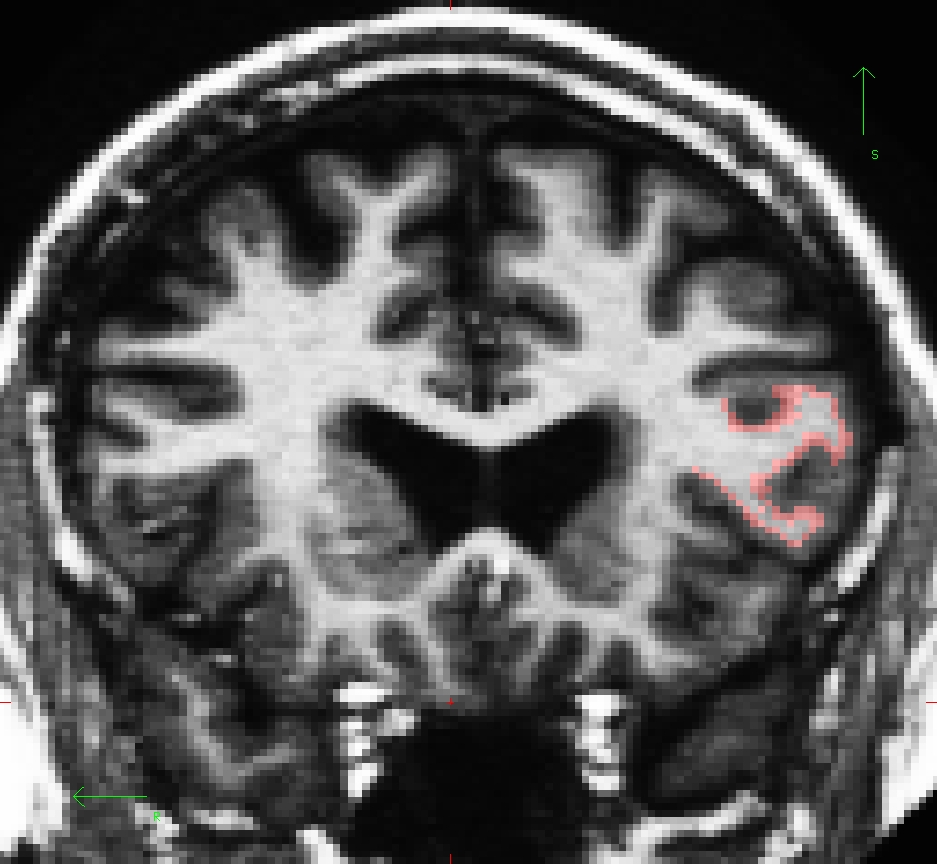
Then on the menu bar at the top of tkmedit tools window, go to File --> Label --> Load Label --> Browse --> lh.BA45.label and hit 'OK' in both windows. The label is visible in coronal slice 153.
This label can be edited when the Select Voxels button is chosen. Use the middle mouse button to add to the label. Use the right mouse button to delete from the label. If this was your own subject, you would want to make sure you save your edits by going to File --> Label --> Save Label but it's not necessary for this tutorial.
To load the label in tksurfer, first load the subject (in another terminal window).
tksurfer 004 lh inflated
On the menu bar at the top of tksurfer tools window, go to File --> Label --> Load Label --> Browse --> lh.BA45.label
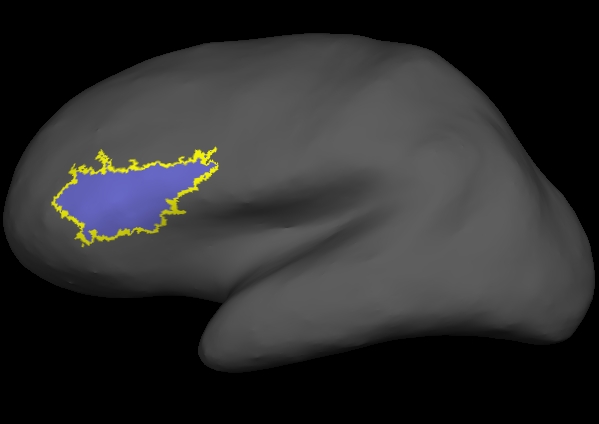
Information on how to create and edit labels in tksurfer can be found on this wiki. You don't have to do this for the tutorial, but please feel free to take a look if you are interested.
Individual Stats files
During the normal FreeSurfer processing stream, via the recon-all script some statistical output files are generated. They are kept in each subjects' stats/ subdirectory and are generated for the subcortical segmentation (aseg) and the cortical parcellation (aparc). These tables include information on each labeled region for the individual subject.
aseg.stats
The statistical output from the subcortical segmentation, called aseg.stats, is a regular text file and will contain the volumes of specific structures. For example, you can obtain information such as the volume of left hippocampus and its mean intensity from this file.
cd $SUBJECTS_DIR/004/stats
less aseg.stats
At the head of the text file there will be information about the command that was run, the version used, the user who ran it and a time stamp. Following this there is information about the volume of the entire brain.
The next section of this file defines the column headers, field name, and units for the rest of the table. We can expect to see the Segmentation Id, Number of Voxels, Volume, Structure Name, Intensity normMean, Intensity normStdDev, Intensity normMin, Intensity normMax, and Intensity normRange for each entry in the table.
The remainder of the table shows this information for all the structures that are labeled in the aseg.
# Title Segmentation Statistics
#
# generating_program mri_segstats
# cvs_version $Id: mri_segstats.c,v 1.69.2.1 2010/07/26 16:19:29 greve Exp $
# cmdline mri_segstats --seg mri/aseg.mgz --sum stats/aseg.stats --pv mri/norm.mgz --empty --excludeid 0 --excl-ctxgmwm --supratent --subcortgray --in mri/norm.mgz --in-intensity-name norm --in-intensity-units MR --etiv --surf-wm-vol --surf-ctx-vol --totalgray --ctab /autofs/cluster/freesurfer/test/subjects/x86_64/buckner_data/group_study_fs5.0.0/freesurfer-Linux-centos4_x86_64-stable-pub-v5.0.0/ASegStatsLUT.txt --subject 004
# sysname  Linux
# hostname compute-0-85.local
# machine  x86_64
# user     nicks
# anatomy_type volume
#
# SUBJECTS_DIR /autofs/cluster/freesurfer/test/subjects/x86_64/buckner_data/group_study_fs5.0.0
# subjectname 004
# Measure lhCortex, lhCortexVol, Left hemisphere cortical gray matter volume, 244507.719492, mm^3
# Measure rhCortex, rhCortexVol, Right hemisphere cortical gray matter volume, 249102.710448, mm^3
# Measure Cortex, CortexVol, Total cortical gray matter volume, 493610.429940, mm^3
# Measure lhCorticalWhiteMatter, lhCorticalWhiteMatterVol, Left hemisphere cortical white matter volume, 260412.984375, mm^3
# Measure rhCorticalWhiteMatter, rhCorticalWhiteMatterVol, Right hemisphere cortical white matter volume, 256990.187500, mm^3
# Measure CorticalWhiteMatter, CorticalWhiteMatterVol, Total cortical white matter volume, 517403.171875, mm^3
# Measure SubCortGray, SubCortGrayVol, Subcortical gray matter volume, 183995.000000, mm^3
# Measure TotalGray, TotalGrayVol, Total gray matter volume, 677605.429940, mm^3
# Measure SupraTentorial, SupraTentorialVol, Supratentorial volume, 1189372.762911, mm^3
# Measure IntraCranialVol, ICV, Intracranial Volume, 1792580.562856, mm^3
# SegVolFile mri/aseg.mgz
# SegVolFileTimeStamp  2010/08/12 21:00:31
# ColorTable /autofs/cluster/freesurfer/test/subjects/x86_64/buckner_data/group_study_fs5.0.0/freesurfer-Linux-centos4_x86_64-stable-pub-v5.0.0/ASegStatsLUT.txt
# ColorTableTimeStamp 2010/08/11 23:17:47
# InVolFile  mri/norm.mgz
# InVolFileTimeStamp  2010/08/12 16:27:10
# InVolFrame 0
# PVVolFile  mri/norm.mgz
# PVVolFileTimeStamp  2010/08/12 16:27:10
# Excluding Cortical Gray and White Matter
# ExcludeSegId 0 2 3 41 42
# VoxelVolume_mm3 1
-
-
-
# TableCol  1 ColHeader Index
# TableCol  1 FieldName Index
# TableCol  1 Units     NA
# TableCol  2 ColHeader SegId
# TableCol  2 FieldName Segmentation Id
# TableCol  2 Units     NA
# TableCol  3 ColHeader NVoxels
# TableCol  3 FieldName Number of Voxels
# TableCol  3 Units     unitless
# TableCol  4 ColHeader Volume_mm3
# TableCol  4 FieldName Volume
# TableCol  4 Units     mm^3
# TableCol  5 ColHeader StructName
# TableCol  5 FieldName Structure Name
# TableCol  5 Units     NA
-
-
-
# ColHeaders  Index SegId NVoxels Volume_mm3 StructName normMean normStdDev normMin normMax normRange
  1   4     31149    31149.0  Left-Lateral-Ventricle            21.2596    10.2600     6.0000    84.0000    78.0000
  2   5      1360     1360.0  Left-Inf-Lat-Vent                 37.3251    12.8335    12.0000    83.0000    71.0000
  3   7     12845    12845.0  Left-Cerebellum-White-Matter      87.6037     7.6264    40.0000   124.0000    84.0000
  4   8     48371    48371.0  Left-Cerebellum-Cortex            60.9231     9.6107    19.0000   107.0000    88.0000
  5  10      7197     7197.0  Left-Thalamus-Proper              85.0192    11.4083    21.0000   118.0000    97.0000
  6  11      5829     5829.0  Left-Caudate                      71.9549    11.1561    28.0000   109.0000    81.0000
  7  12      8389     8389.0  Left-Putamen                      77.1418     9.1256    26.0000   107.0000    81.0000
-
-
-
aparc.stats
The statistical output from the cortical parcellation, called lh.aparc.stats and rh.aparc.stats, is a regular text file and will contain the thickness of specific structures. For example, you can obtain information such as, how big is left superior temporal gyrus and its average thickness from this file.
cd $SUBJECTS_DIR/004/stats
less lh.aparc.stats
At the head of the text file there will be information about the command that was run, the version used, the user who ran it and a time stamp. Following this there is information about the volume of the entire brain. This shows the number of vertices in the cortex (NumVert), and the surface area of the cortex (SurfArea). This part of the file also tells us that the lh.aparc.annot is being used as the annotation file (AnnotationFile ../label/lh.aparc.annot).
The next section of this file defines the column headers, field name, and units for the rest of the table. We can expect to see the Structure Name, Number of Vertices, Surface Area, Gray Matter Volume, Average Thickness, Thickness StDev, Integrated Rectified Mean Curvature, Integrated Rectified Gaussian Curvature, Folding Index and Intrinsic Curvature Index for each entry in the table.
The remainder of the table shows this information for all the structures that are labeled in the aparc.
# Table of FreeSurfer cortical parcellation anatomical statistics
#
# CreationTime 2010/08/13-05:08:41-GMT
# generating_program mris_anatomical_stats
# cvs_version $Id: mris_anatomical_stats.c,v 1.68 2010/05/28 20:36:45 nicks Exp $
# mrisurf.c-cvs_version $Id: mrisurf.c,v 1.678 2010/05/28 21:22:21 rpwang Exp $
# cmdline mris_anatomical_stats -mgz -cortex ../label/lh.cortex.label -f ../stats/lh.aparc.stats -b -a ../label/lh.aparc.annot -c ../label/aparc.annot.ctab 004 lh white
# sysname  Linux
# hostname compute-0-85.local
# machine  x86_64
# user     nicks
#
# SUBJECTS_DIR /autofs/cluster/freesurfer/test/subjects/x86_64/buckner_data/group_study_fs5.0.0
# anatomy_type surface
# subjectname 004
# hemi lh
# AnnotationFile ../label/lh.aparc.annot
# AnnotationFileTimeStamp 2010/08/13 01:08:34
# Measure Cortex, NumVert, Number of Vertices, 142825, unitless
# Measure Cortex, SurfArea, Surface Area, 95354.8, mm^2
# Measure Cortex, MeanThickness, Mean Thickness, 2.31065, mm
-
-
-
# TableCol  1 ColHeader StructName
# TableCol  1 FieldName Structure Name
# TableCol  1 Units     NA
# TableCol  2 ColHeader NumVert
# TableCol  2 FieldName Number of Vertices
# TableCol  2 Units     unitless
# TableCol  3 ColHeader SurfArea
# TableCol  3 FieldName Surface Area
# TableCol  3 Units     mm^2
# TableCol  4 ColHeader GrayVol
# TableCol  4 FieldName Gray Matter Volume
# TableCol  4 Units     mm^3
# TableCol  5 ColHeader ThickAvg
# TableCol  5 FieldName Average Thickness
# TableCol  5 Units     mm
-
-
-
# ColHeaders StructName NumVert SurfArea GrayVol ThickAvg ThickStd MeanCurv GausCurv FoldInd CurvInd
bankssts                                 1630   1133   2693  2.331 0.489     0.137     0.042       19     2.9
caudalanteriorcingulate                  1248    805   2396  2.657 0.674     0.171     0.105       37     4.5
caudalmiddlefrontal                      3336   2205   6275  2.528 0.562     0.142     0.059       42     7.6
cuneus                                   2513   1597   3129  1.806 0.423     0.174     0.119      128     8.5
entorhinal                                566    403   1837  3.268 0.679     0.139     0.067        8     1.6
-
-
-
Group stats files
This section will run you through using the stats directory in the subjects to perform group stats of certain structures that may be of interest to your study. The following commands will help you combine the data of the subjects you are analyzing into one table that will be easily read into a spreadsheet program. We have considered 6 subjects as examples (004, 021, 040, 067, 080, 092) in the following sections.
Set your SUBJECTS_DIR to the path where you have your subjects to be analyzed.
setenv SUBJECTS_DIR $TUTORIAL_DATA/buckner_data/tutorial_subjs/group_analysis_tutorial
cd $SUBJECTS_DIR
Table of segmentation volumes
This section explains how to create a table of segmentation volumes using the 6 subjects mentioned above.
asegstats2table --subjects 004 021 040 067 080 092 \
  --segno 11 17 18 \
  --tablefile aseg.vol.table
where 11, 17 and 18 correspond to the segmentation label of left caudate, left hippocampus and left amygdala respectively. (You can create a table with all of the labels, not just these three, by omitting the --segno part.)
Click here if you would like to view the list of labels and their corresponding ID numbers again.
The file aseg.vol.table is your output - a text file consisting of the subjects mentioned in the command above and the values for the structures requested. The information in this text file is formatted so it can be easily imported into a spreadsheet program (often used as input for many statistical analysis programs). If you do the ls command, you should see that the text file aseg.vol.table has been created. To see what the file looks like, do:
less aseg.vol.table
To to load the resulting table into a spreadsheet, run:
gnumeric aseg.vol.table
Note: the gnumeric command is meant to be run on a Linux machine. Mac users could install OpenOffice 3.0 to open the table in a spreadsheet and run the command
/Applications/OpenOffice.org.app/Contents/MacOS/scalc aseg.vol.table
In the table, the first cell is volume indicating that the measure is a volume in mm3. In addition to segmentations, you can also get IntraCranialVol (ICV) and BrainSegVol into the table.
About the subject IDs, you'll notice that in the examples we've considered here, each subject is a 3 digit number. Therefore gnumeric thinks it is a number and removes leading 0s. This is a gnumeric issue but probably it would not happen if subject names had characters in them instead of integers.
Table of segmentation mean intensities
Purpose of this section is to demonstrate how you can change what measure you collect for your spreadsheet from volume to mean intensity using the asegstats2table command.
asegstats2table \
  --subjects 004 021 040 067 080 092 \
  --segno 11 17 18 \
  --meas mean \
  --tablefile aseg.mean-intensity.table
Things to do:
- You can load the table into a spreadsheet as explained in the previous section.
Refer to the file FreeSurferColorLUT.txt for the segmentation labels and the corresponding subcortical structures.
less $FREESURFER_HOME/FreeSurferColorLUT.txt
For tutorial purposes, click here to view the contents of the file.
Table of white matter parcellation volumes
The purpose of this section is to show how you can change which segmentation atlas you get stats from (and thus which structures):
asegstats2table \
  --subjects 004 021 040 067 080 092 \
  --segno 3007 3021 3022 4022 \
  --stats wmparc.stats \
  --tablefile wmparc.vol.table
Things to do:
- You can load the table into a spreadsheet.
Refer to the file FreeSurferColorLUT.txt for the segmentation labels and the corresponding subcortical structures.
less $FREESURFER_HOME/FreeSurferColorLUT.txt
For tutorial purposes, click here to view the contents of the file
Table of the surface area of each cortical parcellation in the Desikan atlas
This section explains how to create a table of the surface area of each cortical parcellation in the Desikan atlas (surface area is the default measure).
aparcstats2table --hemi lh \
  --subjects 004 021 040 067 080 092 \
  --tablefile lh.aparc.area.table
You can now load the resulting table into a spreadsheet.
Table of the average thickness of each cortical parcellation in the Destrieux atlas
The purpose of this section is to show how to change the summary measure and the parcellation atlas.
aparcstats2table --hemi lh \
  --subjects 004 021 040 067 080 092 \
  --meas thickness \
  --parc aparc.a2009s \
  --tablefile lh.aparc.a2009.thickness.table
You can now load the resulting table into a spreadsheet.