|
Size: 2014
Comment:
|
Size: 3044
Comment:
|
| Deletions are marked like this. | Additions are marked like this. |
| Line 1: | Line 1: |
| [wiki:Self:FsTutorial top] | [wiki:Self:FsTutorial/FslFeatFreeSurfer previous] | [[FsTutorial|top]] | [[FsTutorial/FslFeatFreeSurfer|previous]] == Mapping automatic segmentations to the functional space == *To follow this exercise exactly be sure you've downloaded the [[FsTutorial/Data|tutorial data set]] before you begin. If you choose not to download the data set you can follow these instructions on your own data, but you will have to substitute your own specific paths and subject names. |
| Line 3: | Line 5: |
| *To follow this exercise exactly be sure you've downloaded the [wiki:Self:FsTutorial/Data tutorial data set] before you begin. If you choose not to download the data set you can follow these instructions on your own data, but you will have to substitute your own specific paths and subject names. == Mapping automatic segmentations to the functional space == |
Type the following prior to beginning the exercises: ---- {{{ tcsh setenv SUBJECTS_DIR $FREESURFER_HOME/subjects/buckner_data/tutorial_subjs cd $SUBJECTS_DIR/fbert-feat ln -s $FREESURFER_HOME/subjects/fsaverage ln -s $FREESURFER_HOME/subjects/bert }}} ---- The subjects 'fsaverage' and 'bert' may already exist in the subjects directory, so ignore any warnings that might be issued that say 'File exists'. |
| Line 10: | Line 20: |
| ---- | |
| Line 11: | Line 22: |
| aseg2feat --feat fbert.feat --aseg aparc+aseg | aseg2feat --feat fbert1.feat --aseg aparc+aseg |
| Line 13: | Line 24: |
| and This command will create fbert.feat/reg/freesurfer/aparc+aseg.nii.gz. These are segmentations, meaning that each voxel has an integer value that corresponds to a particular structure. The mapping from structure number to name is given in ${FREESURFER_HOME}/FreeSurferColorLUT.txt. |
---- This command will create fbert1.feat/reg/freesurfer/aparc+aseg.nii.gz. These are segmentations, meaning that each voxel has an integer value that corresponds to a particular structure. The mapping from structure number to name is given in ${FREESURFER_HOME}/FreeSurferColorLUT.txt. |
| Line 19: | Line 30: |
| ---- | |
| Line 20: | Line 32: |
| avwmaths ./fbert.feat/reg/freesurfer/aparc+aseg.nii.gz \ | fslmaths ./fbert1.feat/reg/freesurfer/aparc+aseg.nii.gz \ |
| Line 22: | Line 34: |
| ./fbert.feat/reg/freesurfer/lh.putamen.nii.gz | ./fbert1.feat/reg/freesurfer/lh.putamen.nii.gz |
| Line 24: | Line 36: |
| ---- | |
| Line 25: | Line 38: |
| ---- | |
| Line 26: | Line 40: |
| tkmedit bert orig -aux brain \ -overlay ./fbert.feat/reg/freesurfer/lh.putamen.nii.gz \ -overlay-reg ./fbert.feat/reg/freesurfer/anat2exf.register.dat \ -fthresh 0.5 -fmid 1 -fslope 1 \ -segmentation ${SUBJECTS_DIR}/bert/mri/aparc+aseg.mgz \ ${FREESURFER_HOME}/FreeSurferColorLUT.txt |
tkmedit bert orig.mgz -aux brain.mgz \ -overlay ./fbert1.feat/reg/freesurfer/lh.putamen.nii.gz \ -overlay-reg ./fbert1.feat/reg/freesurfer/anat2exf.register.dat \ -fthresh 0.5 -segmentation aparc+aseg.mgz |
| Line 33: | Line 45: |
| ---- You should see the image below:<<BR>> {{attachment:tkm-lh.putamen-cor-128-small.jpg}} |
|
| Line 34: | Line 49: |
| You should see the image below:[[BR]] attachment:tkm-lh.putamen-cor-128-small.jpg |
=== 3.0 Creating ROI summaries === Once you have the segmentation mapped to the subject's native functional space, you can create summaries of the functional activation. Eg,: ---- {{{ mri_segstats --seg fbert1.feat/reg/freesurfer/aparc+aseg.nii.gz \ --nonempty --ctab-default \ --in fbert1.feat/stats/cope1.nii.gz --sum fbert1.segstats.dat }}} ---- This will create fbert1.segstats.dat which will be a text file with a table of data. Each row will be a segmentation. The columns will contain various measures, including the number of functional voxels and the mean, stddev, min, max, and range of the cope over each ROI. [[FsTutorial/FslFeatSegStats| Here is an example]]. |
Mapping automatic segmentations to the functional space
To follow this exercise exactly be sure you've downloaded the tutorial data set before you begin. If you choose not to download the data set you can follow these instructions on your own data, but you will have to substitute your own specific paths and subject names.
Type the following prior to beginning the exercises:
tcsh
setenv SUBJECTS_DIR $FREESURFER_HOME/subjects/buckner_data/tutorial_subjs
cd $SUBJECTS_DIR/fbert-feat
ln -s $FREESURFER_HOME/subjects/fsaverage
ln -s $FREESURFER_HOME/subjects/bert
The subjects 'fsaverage' and 'bert' may already exist in the subjects directory, so ignore any warnings that might be issued that say 'File exists'.
1.0 Mapping the segmentations
The cortical and subcortical segmentations automatically generated by freesurfer can be mapped into the functional space, which can be useful for doing region of interest (ROI) analysis. This can be done with aseg2feat:
aseg2feat --feat fbert1.feat --aseg aparc+aseg
This command will create fbert1.feat/reg/freesurfer/aparc+aseg.nii.gz. These are segmentations, meaning that each voxel has an integer value that corresponds to a particular structure. The mapping from structure number to name is given in ${FREESURFER_HOME}/FreeSurferColorLUT.txt.
2.0 Creating binary masks
The segmentation for a particular structure can be extracted to create a binary mask (i.e., a volume where the voxel value is 1 if it is in the structure and 0 otherwise). To make a binary mask of the left putamen, which has been assigned label 12 (see ${FREESURFER_HOME}/FreeSurferColorLUT.txt), use the following command:
fslmaths ./fbert1.feat/reg/freesurfer/aparc+aseg.nii.gz \
    -thr 12 -uthr 12 \
    ./fbert1.feat/reg/freesurfer/lh.putamen.nii.gz
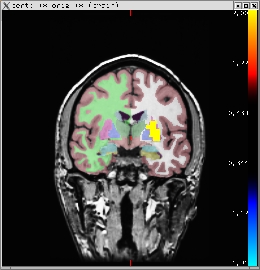
To view this binary mask on the anatomical:
tkmedit bert orig.mgz -aux brain.mgz \
    -overlay ./fbert1.feat/reg/freesurfer/lh.putamen.nii.gz \
    -overlay-reg ./fbert1.feat/reg/freesurfer/anat2exf.register.dat \
    -fthresh 0.5 -segmentation aparc+aseg.mgz
You should see the image below:
3.0 Creating ROI summaries
Once you have the segmentation mapped to the subject's native functional space, you can create summaries of the functional activation. Eg,:
mri_segstats --seg fbert1.feat/reg/freesurfer/aparc+aseg.nii.gz  \
  --nonempty --ctab-default \
  --in fbert1.feat/stats/cope1.nii.gz --sum fbert1.segstats.dat
This will create fbert1.segstats.dat which will be a text file with a table of data. Each row will be a segmentation. The columns will contain various measures, including the number of functional voxels and the mean, stddev, min, max, and range of the cope over each ROI. Here is an example.