|
Size: 740
Comment:
|
Size: 3527
Comment:
|
| Deletions are marked like this. | Additions are marked like this. |
| Line 3: | Line 3: |
| Tracula is tool developed for automatically reconstructing a set of major white matter pathways in the brain from diffusion weighted images using probabilistic tractography. This method obviates the need for manual intervention for tract solutions and thus facilitates the application of tractography to large datasets. | TRACULA is a tool for automatic reconstruction of a set of major white-matter pathways from diffusion-weighted MR images. It uses global probabilistic tractography with anatomical priors. Prior distributions on the neighboring anatomical structures of each pathway are derived from an atlas and combined with the FreeSurfer cortical parcellation and subcortical segmentation of the subject that is being analyzed to constrain the tractography solutions. This obviates the need for user interaction, ''e.g.,'' to draw ROIs manually or to set thresholds on path angle and length, and thus automates the application of tractography to large datasets. |
| Line 7: | Line 7: |
| To use this tool, Please refer to the following tutorials on how to set up and run Tracula | === Documentation === All necessary preprocessing of the diffusion-weighted images and reconstruction of the pathways is done by the '''trac-all''' script. Several options for this analysis stream can be set by the user in a configuration file ('''dmrirc''' file), which is passed as an argument to trac-all. For more information, see: * [[trac-all|trac-all usage]] * [[dmrirc|dmrirc example file]] |
| Line 9: | Line 12: |
| * [[Tracula|Setting Up a Configuration File to run Tracula]] | Specifically the trac-all script can be used to: * Preprocess the diffusion-weighted images, applying standard methods to mitigate image distortions due to eddy currents and B0 field inhomogeneities * Register the individual's diffusion-weighted and structural images to each other and to a common (atlas) space * Reconstruct volumetric distributions of 18 major white-matter pathways included in the atlas * Extract statistics on standard diffusion measures (FA, MD, etc.) for each of the reconstructed pathways Different [[trac-all|trac-all command-line options]] allow the user to run all the above processing steps sequentially or only a single step. |
| Line 11: | Line 19: |
| * [[RunningTracula|Running Tracula]] | The final output of TRACULA, the concatenation of the volumetric distributions of all reconstructed pathways, is a file called merged_*.mgz (the actual name depends on processing options). It can be visualized with [[FreeviewGuide|freeview]]'s -tv option, which displays the volumetric distributions of the pathways as isosurfaces like the ones shown in the image above. |
| Line 13: | Line 21: |
| * [[TraculaOutputs|Outputs from Tracula]] | Note that, because TRACULA relies on the underlying anatomy as derived from the FreeSurfer [[CorticalParcellation|cortical parcellation]] and [[SubcorticalSegmentation|subcortical segmentation,]] these need to be generated before running trac-all. This means that before you run trac-all you will have to analyze your subjects' structural images with [[recon-all|recon-all]] and make sure that they have a good-quality mri/aparc+aseg.mgz. |
| Line 15: | Line 23: |
| * [[TraculaStatistics|Computing Tract Statistics]] | === Tutorials === For step-by-step instructions on how to set up and run TRACULA, see the relevant tutorials from the [[CourseDescription|FreeSurfer training workshops:]] * [[FsTutorial/Tracula|Setting up a configuration file to run TRACULA]] * [[FsTutorial/RunningTracula|Running TRACULA]] * [[FsTutorial/TraculaOutputs|Outputs from TRACULA]] * [[FsTutorial/TraculaStatistics|Computing tract statistics]] === Reference === [[http://www.frontiersin.org/Neuroinformatics/10.3389/fninf.2011.00023/abstract|Automated probabilistic reconstruction of white-matter pathways in health and disease using an atlas of the underlying anatomy.]] Yendiki A, Panneck P, Srinivasan P, Stevens A, Zöllei L, Augustinack J, Wang R, Salat D, Ehrlich S, Behrens T, Jbabdi S, Gollub R and Fischl B (2011). ''Front. Neuroinform.'' 5:23. doi: 10.3389/fninf.2011.00023 |
TRACULA: TRActs Contrained by UnderLying Anatomy
TRACULA is a tool for automatic reconstruction of a set of major white-matter pathways from diffusion-weighted MR images. It uses global probabilistic tractography with anatomical priors. Prior distributions on the neighboring anatomical structures of each pathway are derived from an atlas and combined with the FreeSurfer cortical parcellation and subcortical segmentation of the subject that is being analyzed to constrain the tractography solutions. This obviates the need for user interaction, e.g., to draw ROIs manually or to set thresholds on path angle and length, and thus automates the application of tractography to large datasets.
Documentation
All necessary preprocessing of the diffusion-weighted images and reconstruction of the pathways is done by the trac-all script. Several options for this analysis stream can be set by the user in a configuration file (dmrirc file), which is passed as an argument to trac-all. For more information, see:
Specifically the trac-all script can be used to:
- Preprocess the diffusion-weighted images, applying standard methods to mitigate image distortions due to eddy currents and B0 field inhomogeneities
- Register the individual's diffusion-weighted and structural images to each other and to a common (atlas) space
- Reconstruct volumetric distributions of 18 major white-matter pathways included in the atlas
- Extract statistics on standard diffusion measures (FA, MD, etc.) for each of the reconstructed pathways
Different trac-all command-line options allow the user to run all the above processing steps sequentially or only a single step.
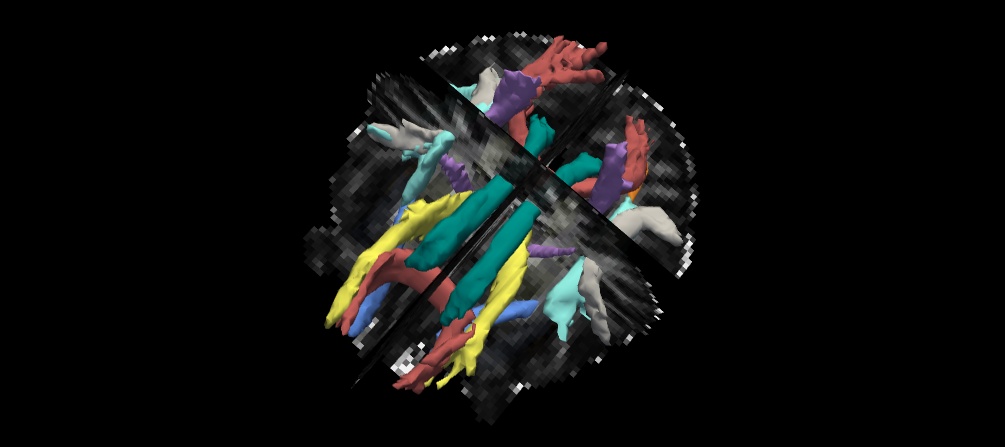
The final output of TRACULA, the concatenation of the volumetric distributions of all reconstructed pathways, is a file called merged_*.mgz (the actual name depends on processing options). It can be visualized with freeview's -tv option, which displays the volumetric distributions of the pathways as isosurfaces like the ones shown in the image above.
Note that, because TRACULA relies on the underlying anatomy as derived from the FreeSurfer cortical parcellation and subcortical segmentation, these need to be generated before running trac-all. This means that before you run trac-all you will have to analyze your subjects' structural images with recon-all and make sure that they have a good-quality mri/aparc+aseg.mgz.
Tutorials
For step-by-step instructions on how to set up and run TRACULA, see the relevant tutorials from the FreeSurfer training workshops:
Reference
Automated probabilistic reconstruction of white-matter pathways in health and disease using an atlas of the underlying anatomy. Yendiki A, Panneck P, Srinivasan P, Stevens A, Zöllei L, Augustinack J, Wang R, Salat D, Ehrlich S, Behrens T, Jbabdi S, Gollub R and Fischl B (2011). Front. Neuroinform. 5:23. doi: 10.3389/fninf.2011.00023